
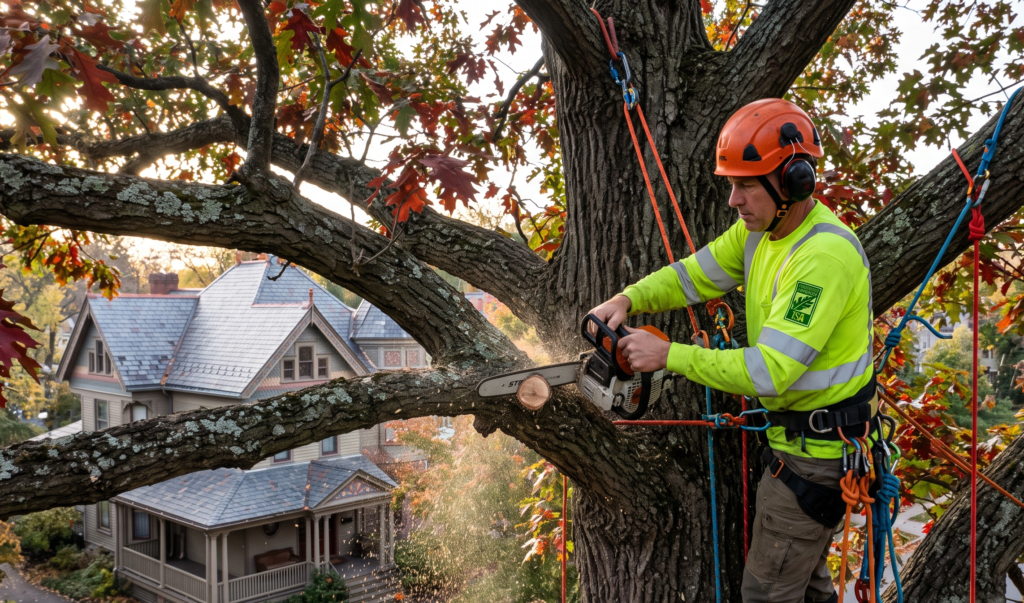
When living among the historic architecture of Western New York, you quickly realize that the century-old canopies lining Delaware Avenue, Lincoln Parkway, and the Elmwood Village are just as vital to our heritage as the Frank Lloyd Wright homes and Victorian facades they shade. However, preserving these mature giants requires a delicate, science-based approach. Homeowners facing sprawling limbs often find themselves weighing two distinct arboricultural practices: when to crown thin vs. crown reduce. Safe pruning for historic Buffalo maples and oaks is not about cosmetic shaping or quick clearance; it is about respecting biomechanics, mitigating heavy lake-effect snow loads, and protecting structural integrity without triggering irreversible decay. At Jensen Star Tree, our ISA-certified arborists navigate these exact challenges across Erie County every season, helping property owners make the right structural pruning decisions before the next winter storm sweeps in off Lake Erie.
Frequently Asked Questions
Why do historic Buffalo trees need specialized pruning strategies?
Buffalo’s older neighborhoods feature mature trees planted close to historic structures, overhead power drops, and narrow streets. Combined with high winds off Lake Erie and early, heavy lake-effect snowstorms, these trees experience distinct physical stresses that generic trimming cannot safely mitigate.
How does ANSI A300 compliance protect my property?
ANSI A300 represents the national standard for tree care operations. Adhering to these standards ensures that any pruning performed protects the tree’s vascular cambium, prevents structural destabilization, and avoids the legal and safety liabilities associated with improper cutting.
The Living Heritage of Buffalo’s Urban Forest
Walk through Buffalo’s Parkside, Hamlin Park, or the Olmsted-designed parkway system, and you will see magnificent Northern Red Oaks (Quercus rubra), White Oaks (Quercus alba), Sugar Maples (Acer saccharum), and Silver Maples (Acer saccharinum) that have stood for 80 to 150 years. These historic trees carry profound cultural, aesthetic, and environmental value:
- Microclimate Moderation: Large-caliper shade trees reduce summer cooling bills across dense city lots by up to 30%.
- Stormwater Interception: A single mature oak captures thousands of gallons of rainfall each year, reducing overflow pressure on Buffalo’s municipal sewer systems.
- Property Valuation: Mature, well-maintained canopies correlate with higher residential curb appeal and property values throughout Erie County.
Yet their longevity is precisely why standard trimming shortcuts can be fatal. Mature trees do not heal like saplings; they compartmentalize wounds. Cut too much, cut too close, or trim at the wrong time of year, and you trigger internal decay that can cause catastrophic limb failure years down the road.
Frequently Asked Questions
What does “compartmentalization” mean in mature trees?
Unlike human tissue, trees cannot replace damaged cells with identical new tissue. Instead, they wall off injured or infected areas using chemical and physical barriers—a biological process known as CODIT (Compartmentalization Of Decay In Trees). Proper cuts respect these natural barriers so decay cannot reach the trunk.
Are mature urban oaks and maples protected by city ordinances?
Trees planted in the public right-of-way (between the sidewalk and the street) are managed by the City of Buffalo Department of Public Works, Parks & Streets. Trees located entirely on private land are the homeowner’s responsibility, though historic preservation districts may provide specific recommendations for significant landscapes.
Anatomy of the Crown: The Core Terminology
Before contrasting crown thinning and crown reduction, it helps to understand standard arboricultural terms established under the ANSI A300 (Part 1) Pruning Standards:
- Crown: The entire upper portion of the tree, consisting of scaffold limbs, lateral branches, twigs, and foliage.
- Scaffold Branches: The primary structural limbs arising directly from the trunk that form the basic framework of the canopy.
- Terminal Leader: The central, upright stem responsible for vertical apical growth.
- Branch Collar & Bark Ridge: The swollen shoulder of tissue at the junction where a branch joins a larger limb or trunk. Safe pruning cuts must never sever or flush-cut this critical protective zone.
- Epicormic Sprouting (“Water Sprouts”): Fast-growing, poorly attached shoots produced by latent buds when a tree experiences sudden stress, over-thinning, or sunscald.
Frequently Asked Questions
Why is cutting into the branch collar dangerous?
The branch collar contains trunk tissue and specialized chemical boundaries that seal wounds. Cutting flush against the trunk removes this defense zone, allowing wood-rot fungi direct access into the heartwood of the trunk.
What causes epicormic sprouting after pruning?
When an arborist removes too much interior foliage, the tree enters an emergency survival state. Dormant buds beneath the bark rapidly sprout to replace lost photosynthetic area. These shoots are weakly anchored in the outer sapwood and break easily in high winds.
What Is Crown Thinning?
Crown thinning is the selective removal of small-diameter lateral branches throughout the interior and secondary canopy, performed uniformly without altering the overall height, spread, or natural silhouette of the tree.
In contrast to exterior reshaping, crown thinning focuses strictly on the interior framework:
- Canopy Perimeter: The outer perimeter, height, and overall spread remain completely unchanged.
- Interior Execution: Weak, crossing, shaded, or competing twigs and small lateral branches are selectively pruned from the interior spaces.
- Resulting Architecture: Foliage density is reduced evenly from the center outward, leaving the tree with an open, balanced branch structure that preserves its natural form.
Purpose and Goals of Crown Thinning
- Wind Resistance Mitigation: Permitting high-velocity gale winds off Lake Erie to filter harmlessly through the canopy (reducing the “sail effect”) rather than hitting an impenetrable wall of foliage.
- Interior Sunlight Penetration: Encouraging balanced foliar distribution rather than leaving interior foliage choked out and dying.
- Air Circulation: Decreasing humidity within dense leaves, directly suppressing fungal blights like anthracnose and powdery mildew.
- Deadwood Removal: Eliminating dead, diseased, crossing, or weakly attached interior branches before they snap.
The Golden Rule of Thinning
Never remove more than 10% to 15% of the living foliage on a mature, historic maple or oak in a single season (and never exceed 20% on any mature tree). Over-thinning leads directly to “lion-tailing”—a dangerous malpractice where an arborist strips all interior lateral branches, leaving foliage clustered only at the very branch tips.
When wind or wet lake-effect snow hits a lion-tailed branch, the weight and leverage are concentrated entirely at the extreme end of the lever arm. This dramatically increases rotational torque at the branch union, leading to branch snapping and trunk failure during sudden November storms.
Frequently Asked Questions
How often should a mature maple or oak undergo crown thinning?
For mature trees in Western New York, a light thinning cycle every 3 to 5 years is typical. This allows sufficient time for the tree to utilize its energy reserves and adjust to wind dynamics without depleting its canopy.
Does crown thinning reduce the overall height of my tree?
No. Crown thinning deliberately leaves the height and spread unchanged. If a branch is encroaching on a roofline or service line, crown reduction or directional clearance pruning is required instead.
What Is Crown Reduction?
Crown reduction is the selective shortening of branches and stems back to strong lateral branches to decrease the actual vertical height or outward spread of the tree’s outer canopy.
Unlike crude topping, proper crown reduction follows a strict biological technique:
- Cut Line Placement: Overextended outer terminals are shortened back to an existing, healthy lateral branch.
- The Lateral Ratio: The lateral branch selected to assume the lead must measure at least one-third the diameter of the parent stem being cut.
- Biological Function: This remaining lateral sustains active sap flow and photosynthetic energy to the cut end, preventing branch-tip dieback while reducing overall height and perimeter spread.
Unlike crude “topping,” true crown reduction utilizes drop-crotch pruning. Each reduction cut terminates at a viable lateral branch that is at least one-third the diameter of the stem being cut. This remaining lateral assumes apical dominance, drawing sap and sustaining photosynthetic energy so the cut end can form woundwood rather than rotting away.
Purpose and Goals of Crown Reduction
- Target Clearance: Relieving branches growing directly toward roofs, brick chimneys, historic slate shingles, or overhead service drops.
- Leverage Relief: Shortening an overextended limb that is bearing too much end-weight over a driveway or sidewalk.
- Structural Failure Mitigation: Stabilizing trees with co-dominant stems (twin trunks), included bark, or internal hollows by lowering the canopy center of gravity.
- Storm Damage Recovery: Safely reforming a canopy after the top of a tree has been snapped by high winds or heavy ice.
Frequently Asked Questions
How is crown reduction different from tree topping?
Topping involves indiscriminate cuts across branch stubs without regard to lateral branch placement, causing massive decay and dense clusters of hazardous water sprouts. Crown reduction cuts only back to viable lateral branches that can maintain apical control and nourish the cut site.
How much height can safely be removed during a crown reduction?
An arborist generally aims to reduce branch length by no more than 20% to 25% of its total reach in a single operation, ensuring that the remaining lateral limb has adequate foliage to sustain the remaining limb segment.
Crown Thinning vs. Crown Reduction: Direct Comparison
| Arboricultural Feature | Crown Thinning | Crown Reduction |
| Primary Objective | Increase light/air flow; reduce wind sail. | Decrease overall height or horizontal spread. |
| Effect on Silhouette | Retains natural shape, height, and width | Reduces outer perimeter; compacts canopy |
| Typical Cut Size | Small-diameter laterals (under 2 inches) | Larger terminal branches back to 1/3-diameter laterals |
| Stress Level on Mature Trees | Low to moderate (when done under 15%) | Moderate to high; requires strict limits |
| Snow Load Defense | Allows snow to pass through interior branches | Reduces bending leverage on extended scaffold limbs |
| Best Used For | Dense, healthy trees with trapped interior moisture | Overextended limbs, utility interference, structural cracks |
| Risk If Done Poorly | Lion-tailing, tip snaps, sunscald | Internal heartwood decay, excessive water sprouts, dieback |
Frequently Asked Questions
Can both thinning and reduction be performed in the same visit?
Yes, but with strict conservation. If an overextended limb requires reduction while the interior canopy is severely congested, both techniques can be applied as long as total foliage removal remains well under the 15% threshold for mature trees.
Which method is better for managing winter storm risk?
Both play complementary roles. Crown thinning reduces the “sail effect” during gale-force winds, while crown reduction shortens long horizontal levers that would otherwise buckle under dense, wet lake-effect snow.
Species-Specific Guidelines: Historic Buffalo Maples
Sugar maples (Acer saccharum), red maples (Acer rubrum), and historic silver maples (Acer saccharinum) define countless parkways in Parkside, Central Park, and University Heights. However, their wood density, compartmentalization capacity, and response to pruning cuts vary considerably.
Sugar Maples (Acer saccharum)
- Decay Sensitivity: High. Sugar maples have tight, dense wood but compartmentalize decay walls slowly compared to oaks.
- Pruning Tolerance: Low. They resent aggressive pruning. Never thin more than 10–12% of living leaf area.
- Preferred Method: Minimal crown thinning combined with selective, light reduction only when an over-extended limb threatens a target.
- Sap Flow Timing: Sugar maples experience intense hydrostatic pressure in late winter and early spring (“bleeding”). While sap weeping does not inherently weaken the tree, pruning in late summer (July through September) or during full winter dormancy avoids sap weeping and minimizes stress.
Silver Maples (Acer saccharinum)
- Wood Characteristics: Brittle, fast-growing, prone to narrow crotches with included bark.
- Lake Effect Hazard: Silver maples are historically the leading tree casualty during early autumn snowstorms because their brittle limbs carry massive leaf-and-snow surface areas.
- Preferred Method: Targeted crown reduction to shorten heavy, overextended horizontal limbs before they sheer off over roofs. Thinning alone is often insufficient because the remaining tip wood remains brittle.
Frequently Asked Questions
Does heavy sap flow harm my maple if it is pruned in late winter?
No. While sap dripping can be messy on driveways and patios, it is primarily water and dissolved sugars moved by root pressure. The flow naturally stops once buds leaf out in spring.
Why do silver maples split so easily compared to sugar maples?
Silver maples grow rapidly and develop tight “V-shaped” branch unions with bark trapped inside the joint (included bark). This creates a structural weak point that cannot support heavy snow accumulation without splitting.
Species-Specific Guidelines: Historic Buffalo Oaks
Oaks are the crown jewels of Buffalo’s urban canopy. The sprawling Red Oaks (Quercus rubra) and stately White Oaks (Quercus alba) in Delaware Park and private estates can live for centuries if shielded from mechanical trauma and infectious diseases.
The Critical Oak Pruning Window: Oak Wilt Caution
Oak wilt (Bretziella fagacearum) is a lethal vascular fungus transmitted by nitidulid sap-feeding beetles. These beetles are strongly attracted to fresh tree wounds.
- Active Transmission Window: April 1 through July 31 (and increasingly into late autumn during warmer years).
- The Rule: Never prune oaks during spring or summer. Safe pruning for historic buffalo oaks should strictly occur during deep winter dormancy (November through March). During this dormant phase, beetles are inactive, the fungus cannot spread, and the tree’s energy reserves are safely stored underground in root systems.
Red Oaks vs. White Oaks
- Red Oaks: Porous vascular structure; more vulnerable to oak wilt and swift capillary decline. Reduction cuts must be kept to absolute structural necessity.
- White Oaks: Superior compartmentalization thanks to tyloses (balloon-like outgrowths that plug vascular vessels against invading rot). They tolerate careful crown thinning well to alleviate wind drag off Lake Erie, provided branch collars are strictly preserved.
Frequently Asked Questions
What should I do if an oak branch breaks in June during a storm?
If an oak branch breaks during the high-risk beetle window (April–July), the wound must be cleaned with a fresh cut and immediately sealed with a specialized wound dressing or water-based paint. While paint is normally discouraged in arboriculture, oak wilt prevention is the major recognized exception.
How can I identify oak wilt symptoms?
Symptoms include rapid leaf discoloration starting at the outer leaf margins, leaf wilting, and widespread premature leaf drop in mid-to-late summer, often progressing from the top of the canopy downward.
The Buffalo Climate Factor: Lake-Effect Snow, Freezing Rain, and Wind Shear
Western New York’s geographical placement between Lake Erie and Lake Ontario creates microclimatic strains that standard national pruning manuals simply do not address:
1. The Lake Erie Wind Shear
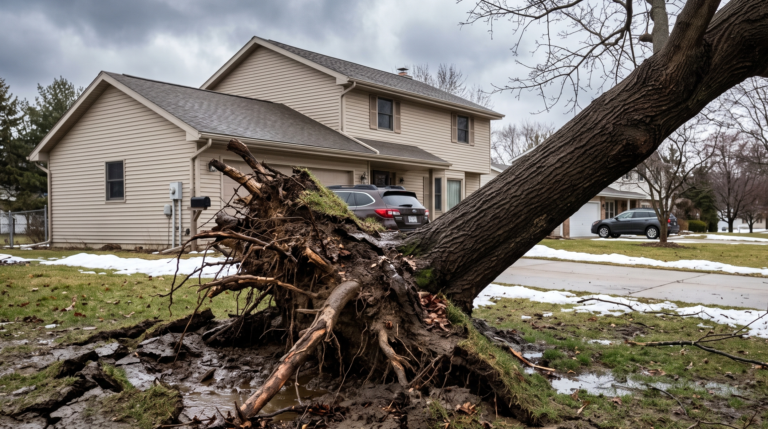
Sustained autumn and winter gales regularly push 50–65 mph gusts through neighborhoods like Elmwood, Black Rock, and South Buffalo. A dense, unpruned tree acts like a solid ship’s sail, transferring immense overturning force down into root plates.
2. Early-Season Lake-Effect Wet Snow
Lake-effect precipitation is notoriously heavy, dense, and waterlogged (“concrete snow”). When an early snowstorm strikes while maples and oaks still hold their autumn foliage, the cumulative weight on horizontal limbs reaches thousands of pounds.
Frequently Asked Questions
Why does early autumn snow cause more damage than mid-winter snow?
Early storms arrive when trees still retain their foliage. Leaves provide thousands of square feet of extra surface area that catch and hold heavy wet snow, multiplying the weight on limbs by several orders of magnitude.
Can pruning prevent a healthy tree from uprooting in high winds?
Crown thinning reduces the wind resistance of the canopy, lowering the rotational force transferred to the root plate. While it cannot fix severely rotted roots or severed root systems, it significantly reduces the likelihood of whole-tree failure in sound soil.
Diagnosing Your Tree: Which Pruning Method Does It Need?
When a homeowner contacts Jensen Star Tree, an arborist conducts a systematic Level 2 visual risk assessment (per ISA Tree Risk Assessment Qualification / TRAQ standards). Here is how we diagnose the tree’s requirements:
Scenario A: The Tree Is Dense and Dark, But Structurally Sound
- Symptoms: Grass cannot grow beneath the canopy; interior twigs are brittle and leafless; fungal spots appear across inner foliage; wind pushes the entire tree violently as a single mass.
- Diagnosis: Excessive canopy density.
- Corrective Action: Crown Thinning. Thin up to 10–15% of crossing, dead, and rubbing interior branches. Retain outer branch tips and overall height.
Scenario B: Sprawling Limbs Hang Over Roofs or Driveways
- Symptoms: Heavy horizontal limbs extend 25+ feet outward, sagging noticeably in rain; tips brush historic roof slate or gutters; trunk shows minor stress ripples near branch attachments.
- Diagnosis: Excessive lever-arm weight and structural clearance conflict.
- Corrective Action: Crown Reduction. Utilize drop-crotch cuts to prune terminal ends back to secondary laterals, shortening limb span and raising ground clearance safely.
Scenario C: Co-Dominant Trunks with Included Bark
- Symptoms: The tree forks into two major stems, forming a tight “V” shape rather than an open “U” shape; bark is pinched tightly between them; seams or cracks appear below the union.
- Diagnosis: High risk of stem splitting during heavy icing.
- Corrective Action: Subordination Pruning via Crown Reduction (Often Paired with Dynamic Cabling). Reduce the height and foliage volume of one side of the “V” to subordinate it, allowing the other stem to become the primary leader while reducing splitting force.
Frequently Asked Questions
What is “included bark,” and why is it dangerous?
Included bark occurs when two stems grow so close together that their bark presses inward rather than forming joined wood. Because the stems are not structurally knit together, they act like two levers prying apart during wind or snow storms.
What is a Level 2 Tree Risk Assessment?
It is a comprehensive 360-degree ground-level inspection by an ISA-certified arborist evaluating the crown, scaffold branches, trunk, and root flare for signs of fungal fruiting bodies, decay pockets, structural cracks, and lean.
What Never to Do: The Danger of “Topping” and Flush Cuts
In historic preservation arboriculture, certain outdated practices are strictly avoided because they initiate irreversible decline:
- Indiscriminate Topping Cuts: When branches are cut at arbitrary stubs between growth nodes, the tree cannot compartmentalize the open wound. Decay organisms penetrate directly down the pith into the heartwood, while the cut surface explodes with weak, poorly anchored water sprouts that detach easily under moderate wind.
- Proper ANSI A300 Reduction Cuts: The cut is made cleanly at a 45-degree angle just outside the branch bark ridge of a viable lateral branch. The remaining lateral continues normal transpiration and nutrient transport, keeping the branch collar active and allowing the tree to seal off the cut face with healthy callus tissue.
Key Practices to Avoid
- Topping (Stub Cuts): Cutting main scaffold limbs off at arbitrary points between nodes leaves blunt stubs. The tree cannot close these wounds; wood-decay fungi enter heartwood, and the tree reacts by exploding with weakly anchored water sprouts that blow off in moderate winds.
- Flush Cutting: Sawing flat against the trunk removes the branch collar and branch bark ridge. This strips the tree’s natural chemical defense zone (Wall 4 of CODIT—Compartmentalization Of Decay In Trees), guaranteeing trunk cavity rot.
- Over-Thinning (Lion-Tailing): Gutting the entire interior of the canopy leaves thin, whipping branches with all their leaf mass at the periphery. This destabilizes the tree’s natural damping mechanics in wind storms.
Frequently Asked Questions
Can a topped tree ever fully recover?
A mature tree topped with a tree never regains its original structural strength. While arborists can sometimes manage the resulting regrowth through corrective thinning and crown restoration over several years, the internal decay at the cut stubs remains permanent.
Why do some contractors still practice topping?
Topping requires little training, equipment, or understanding of plant physiology. It provides an immediate, artificial drop in tree height but creates severe long-term structural hazards for the property owner.
Working Near Historic Structures & Municipal Guidelines in Buffalo
Pruning historic trees across Erie County often involves navigating local property codes and historic preservation guidelines:
- Buffalo Preservation Board: If your property is in an established historic district (e.g., Allentown, 500 block of Main, Delaware Preservation District), certain landscape features and significant trees may carry local covenants or require notification before drastic removals or reshaping.
- City Right-of-Way Trees: Trees situated between the sidewalk and curb belong to the City of Buffalo Department of Public Works, Parks & Streets. Private homeowners should never trim street trees themselves; work must be performed or permitted through the city forester.
- Utility Lines: Limbs encroaching within 10 feet of high-voltage transmission lines require utility-certified tree clearance specialists (such as National Grid line clearance crews). Never attempt DIY pruning or hire uncertified contractors near electrical infrastructure.
Frequently Asked Questions
How do I find out if my tree is located in the city right-of-way?
Check your property survey or contact the City of Buffalo Department of Public Works. Generally, trees positioned between the sidewalk curb and the property boundary line fall under municipal jurisdiction.
Do historic district rules prohibit tree pruning?
No. Routine maintenance, structural thinning, and corrective reduction that protect both historic structures and tree health are encouraged, provided they follow standard arboricultural practices rather than disfiguring methods.
The Value of Professional Arboriculture: Why Trust Jensen Star Tree?
Caring for mature oaks and maples is an investment in living architecture. At Jensen Star Tree , our crews specialize in the preservation and structural management of mature residential and commercial trees throughout Buffalo, Williamsville, Amherst, Orchard Park, and surrounding WNY communities.
Our Standard of Care
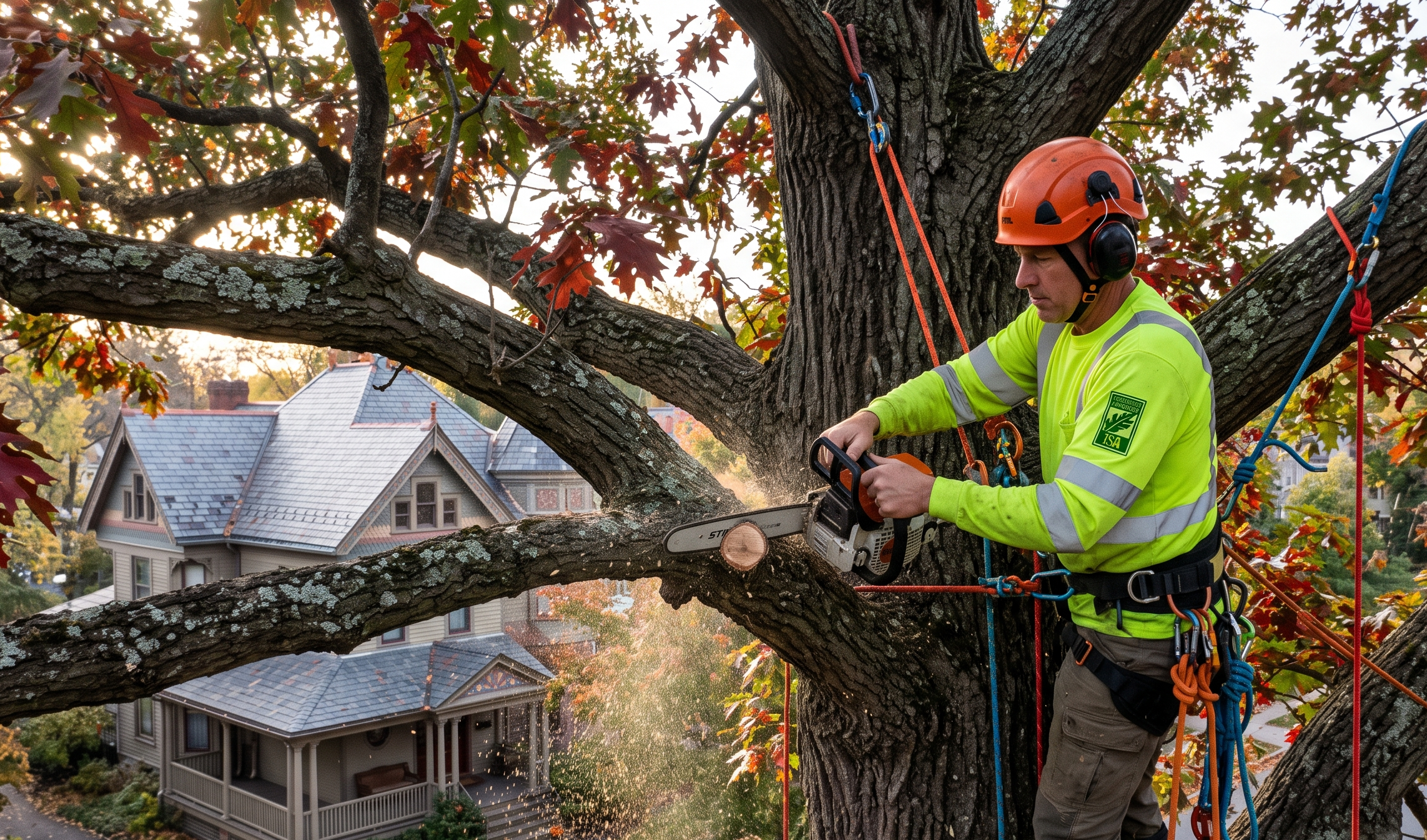
- ISA-Certified Arborists: We adhere strictly to ANSI A300 pruning specifications and ANSI Z133 safety mandates.
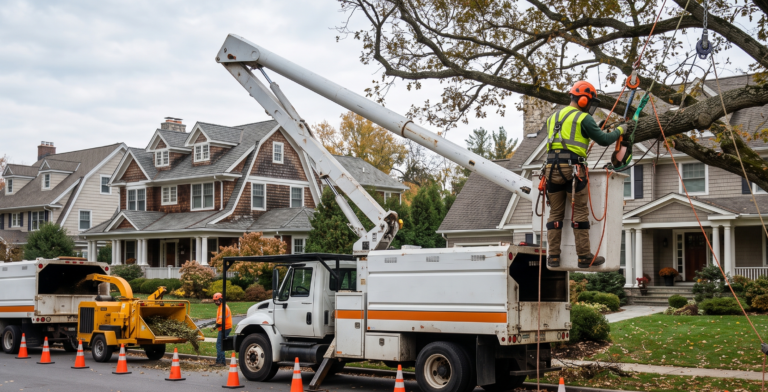
- Low-Impact Rigging: We utilize modern canopy access techniques and friction rigging to lower heavy limbs without damaging historic slate roofs, copper gutters, brick pavers, or ornate iron fencing below.
- Comprehensive Plant Health Care: Beyond pruning, we evaluate soil compaction, root girdling, and fungal pathogens to keep your century-old trees thriving for the next generation.
Frequently Asked Questions
What credentials should I look for when hiring a tree care provider?
Always confirm that the company employs ISA (International Society of Arboriculture). Certified Arborists carries comprehensive general liability and workers’ compensation insurance and operates in accordance with ANSI A300 standards.
How do you protect delicate landscaping and historic architecture during work?
Our teams use specialized aerial lifts and non-invasive, rope-and-pulley rigging systems to systematically lower each severed branch under tension, preventing ground impacts on historic pavers, slate roofs, and gardens.
Looking for Certified Tree Pruning & Trimming Near You in Buffalo?
When property owners search for “tree trimming near me” or “tree pruning services near me” across Erie County, proximity and certified credentials are the two most critical factors. An emergency limb removal or delicate crown reduction on a historic tree cannot wait for an out-of-area crew unfamiliar with Buffalo’s architectural layouts, narrow city driveways, and lake-effect wind patterns.
At Jensen Star Tree, our certified arborists operate right in your neighborhood. Whether you are searching for local tree care near:
- North Buffalo & Hertel Avenue: Tight zero-lot-line pruning protecting shared driveways and garages.
- Elmwood Village & Allentown: Delicate, low-impact rigging around historic slate roofs, copper gutters, and Victorian trim.
- Parkside & Delaware Park: Preservation pruning for century-old Olmsted-district red oaks and sugar maples.
- Suburban Erie County (Amherst, Williamsville, Orchard Park): Large-acreage canopy management, end-weight reduction, and proactive storm prep.
We provide prompt, on-site hazard evaluations within our dedicated Western New York service area.
Frequently Asked Questions
How quickly can an arborist near me evaluate my tree?
Jensen Star Tree provides rapid on-site visual assessments throughout Buffalo and Erie County. For hanging or split limbs following a winter storm or summer wind shear, emergency hazard dispatch is available.
Does Jensen Star Tree service my specific neighborhood in Buffalo?
Yes. We actively service residential, historic, and commercial properties throughout the City of Buffalo, Amherst, Williamsville, Cheektowaga, West Seneca, Orchard Park, and Hamburg.
Our Buffalo Service Area & Location
📍 Service Area: Buffalo, NY, and surrounding Erie County communities. Call our dispatch office directly or request your on-site quote via our official service request page.
Schedule a Canopy Consultation in Western New York
Whether your sprawling sugar maple needs targeted wind-load thinning or an ancient red oak requires careful reduction back from your roofline, proper pruning protects both your property and Buffalo’s urban forest.
Contact the certified tree care team at Jensen Star Tree today to schedule a comprehensive tree risk assessment and custom pruning plan for your historic trees.