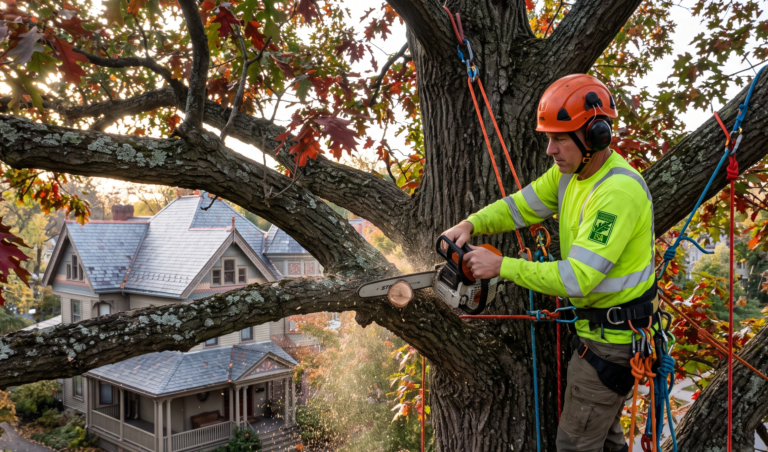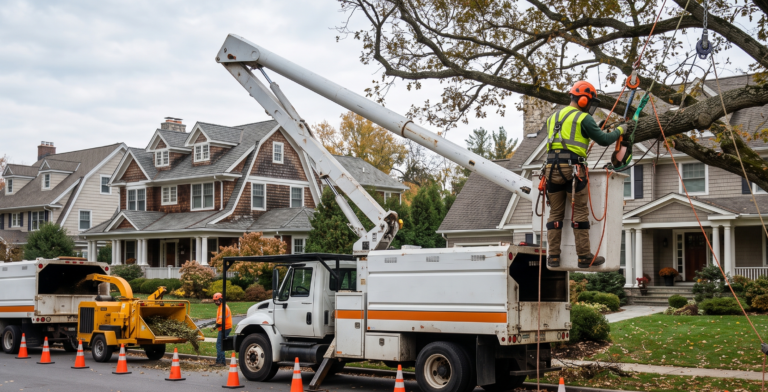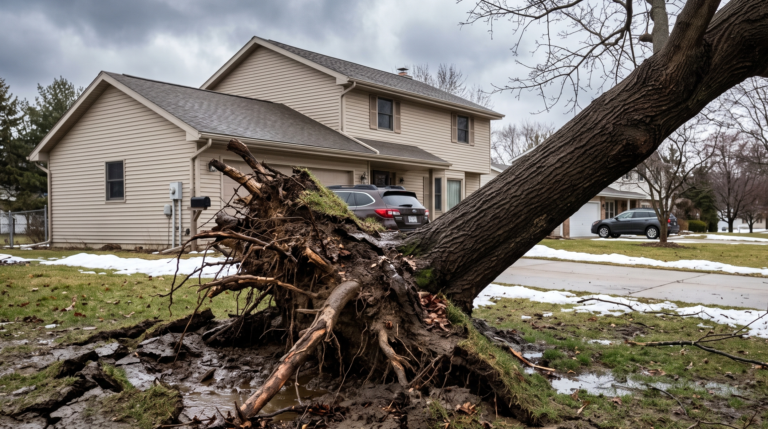

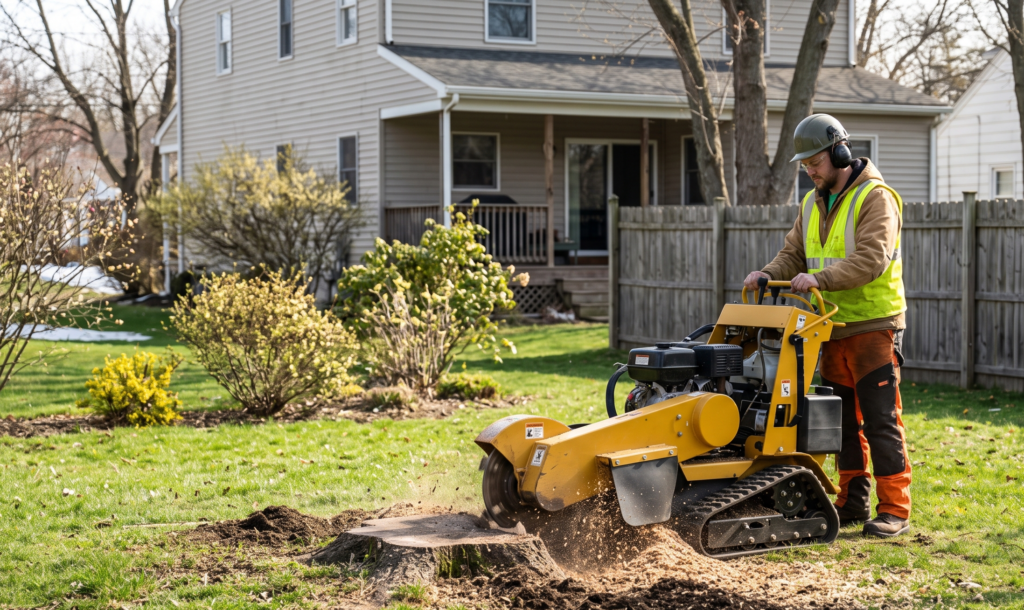
When the heavy Western New York snowpack finally recedes and temperatures climb across Erie County, homeowners throughout the Queen City head outdoors to assess the aftermath of another harsh winter. If storm blowdowns, winter dieback, or emerald ash borer mitigation prompted a tree felling on your parcel over the dormant season, you are almost certainly faced with an unsightly, weather-beaten wooden remnant jutting through the early thaw. Deciding between stump grinding vs. stump removal is one of the most critical structural lawn investments you will make this season, as each approach triggers distinct consequences for turfgrass establishment, root-zone biology, yard aesthetics, and overall project costs. At Jensen Star Tree, our local arborists and heavy-equipment operators consult daily with residential and commercial property owners to match soil conditions, subsurface utility parameters, and budget goals with the correct mechanical intervention.
Eliminating a dead tree at ground level solves only the vertical half of your property’s equation. Below the cut surface lies a complex anchor system comprising the root flare, primary buttress roots, taproots, and extensive lateral feeder lines that often stretch two to three times the width of the original canopy. Choosing whether to pulverize this central mass into nutrient-rich organic mulch or extract the complete root plate with heavy earthmoving equipment determines whether your lawn recovers in three weeks or requires months of restorative grading. Below, our field crew breaks down the operational, ecological, and economic variables defining spring stump management across Buffalo and Western New York.
Frequently Asked Questions
Why is early spring the ideal window for addressing tree stumps in Western New York?
Early spring provides thawed, workable soil that yields easily to cutting teeth while aligning perfectly with the prime April-to-May germination window for cool-season turfgrasses before summer heat sets in.
Can a low-cut stump safely be left alone to decompose beneath growing grass?
No. Aside from wrecking rotary mower blades and deck spindles, an untreated stump creates a severe subsurface tripping hazard, harbors wood-destroying insects, and incubates aggressive root-rot fungal pathogens.
What Happens to Tree Stumps During a Western New York Winter?
Buffalo winters subject subterranean root plates to extreme hydraulic and thermal stresses. Situated between Lake Erie and Lake Ontario, the regional soil environment endures repeated cycles of heavy saturation, deep freezing down to the local 42-inch frost line, and sudden, rapid spring melts. While a tree stump may sit quietly under two feet of lake-effect snow, subterranean biological and physical shifts are continuously underway.
1. Frost Heave Dynamics in Glacial Till and Clay Soils
Much of Erie County—especially across neighborhoods in South Buffalo, West Seneca, Cheektowaga, and Tonawanda—features high-density lacustrine clay and glacial till. Clay holds water tenaciously. As trapped groundwater freezes, expands, and exerts upward hydrostatic pressure, it physically pushes buried root flares closer to the surface. A stump cut nearly flush in October frequently protrudes one to two inches higher by April, turning into an unexpected mower-blade trap.
2. High-Moisture Incubation of Fungal Pathogens
Deep snow blankets act as thermal insulators, keeping the underlying stump damp and shielded from drying winds. As early spring ambient temperatures cross 50°F, dormant spores of structural wood-decay fungi quickly awaken. Species such as Armillaria mellea (honey fungus), Ganoderma applanatum (artist’s bracket), and various saprophytic wood-rotting organisms colonize the porous vascular cambium. Left untreated, these fungal mycelia travel outward along dead root channels, potentially infecting the living root crowns of nearby ornamental trees and shrubs.
3. Subterranean Insect Awakening and Colonization
Eastern subterranean termites (Reticulitermes flavipes) and black carpenter ants (Camponotus pennsylvanicus) emerge from winter dormancy hungry for softened cellulose. A wet, decomposing stump situated within 30 feet of your house foundation, porch footings, or garage sill plate acts as a major regional attractor. These wood-destroying insects establish foundational satellite colonies inside the softened heartwood before foraging toward structural framing members in residential homes.
Frequently Asked Questions
Does sub-zero Buffalo winter cold kill off termite colonies inside a yard stump?
No. Subterranean termites retreat below the local frost line or use the interior heartwood of the stump as thermal insulation, resuming active feeding the moment ground temperatures climb above 50°F.
Can tree roots keep growing after the main trunk has been cut down?
The severed trunk cannot support foliage, but species with aggressive root vigor (such as silver maples, boxelder, and willows) frequently use stored root starch reserves to push up nuisance suckers and water sprouts throughout spring.
Defining the Methods: Stump Grinding vs. Complete Stump Removal
Selecting the best mechanical approach begins with understanding what our crews do on-site during each procedure. While both techniques clear your landscape of surface obstacles, their engineering footprints are completely distinct.
What Is Stump Grinding?
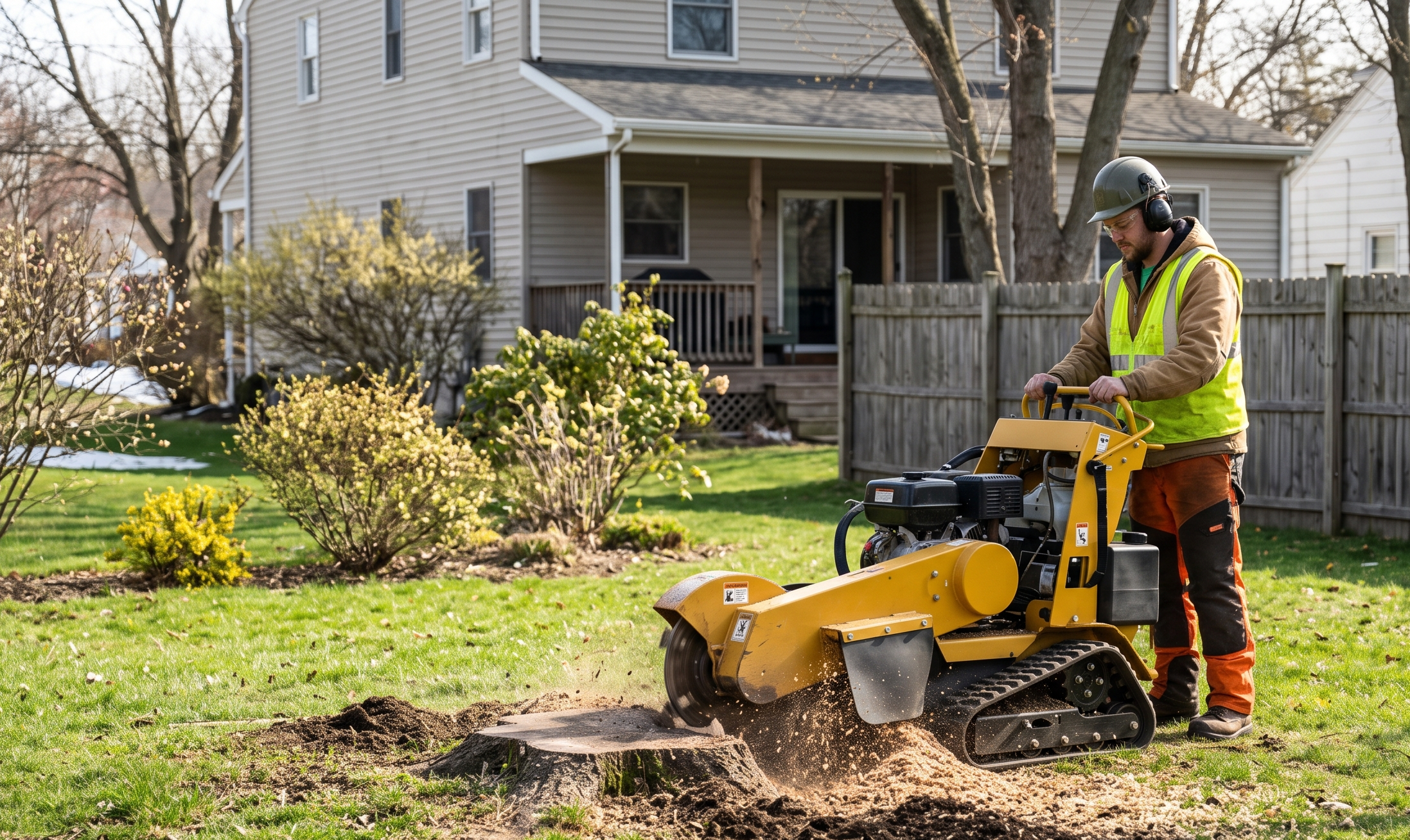
Stump grinding is a focused, mechanical reduction process designed to eradicate the visible stump, upper root crown, and major surface buttress roots without excavating the surrounding yard.
- The Equipment: The workhorse of this process is a dedicated walk-behind or rubber-tracked stump grinder driven by a 25- to 75-horsepower engine. The cutting head consists of a heavy steel wheel fitted with rugged, carbide-tipped cutting teeth that spin at approximately 1,500 to 2,000 RPM.
- Operational Execution: The operator sweeps the spinning cutting wheel back and forth across the stump, incrementally shaving down the wood fibers one to two inches per pass.
- Target Depth: Standard professional operations mill the wood down between 8 and 14 inches below finished lawn grade. Specialized passes can reach 18 inches deep if needed for specific hardscaping or shrub bed installations.
- Resulting Byproduct: The process blends chipped wood fiber with existing topsoil, producing a nutrient-rich organic mulch that temporarily mounds inside the grinding pit.
- Root Fate: Lateral anchor roots situated deep underground remain intact to decompose naturally over several years, keeping surrounding soil stable and undisturbed.
What Is Complete Stump Removal?
Complete stump removal (often termed grubbing or total mechanical excavation) is an aggressive, earthmoving operation designed to pull the entire root plate out of the earth.
- The Equipment: This method requires heavy civil machinery—typically a 5- to 10-ton mini-excavator or backhoe equipped with an articulated hydraulic thumb, a trenching bucket, and heavy-gauge root-ripping teeth.
- Operational Execution: The operator digs a wide, continuous perimeter trench around the root flare, severing lateral roots with axes, saws, and mechanical rippers. Once freed from horizontal soil tension, the machine uses hydraulic leverage to pry the central taproot and structural root ball out of the ground.
- Target Depth: The excavation penetrates anywhere from 3 to 6 feet deep, clearing all structural subterranean wood.
- Resulting Byproduct: You are left with an enormous, soil-caked root ball weighing anywhere from 500 pounds to over two tons, which must be hoisted onto a dump trailer and hauled off to an organic recycling facility.
- Resulting Footprint: A significant crater remains that equals the full volume of the excavated root system, requiring multiple cubic yards of imported structural fill dirt and topsoil to restore grade.
Frequently Asked Questions
How loud is the stump grinding process?
A commercial stump grinder produces noise levels similar to a commercial riding mower or wood chipper (roughly 85 to 95 decibels). Our crews wear hearing and eye protection and set up protective ballistic screens to contain flying debris.
Will stump grinding equipment fit through a standard residential fence gate?
Yes. Our modern tracked grinders feature retractable undercarriages that easily fit through standard 36-inch walk gates, eliminating the need to take down fence sections.
Head-to-Head Comparison: Grinding vs. Removal
| Feature / Factor | Professional Stump Grinding | Complete Stump Removal (Excavation) |
| Excavation Depth | 8 to 14 inches below grade (up to 18″ on demand) | Full root plate depth (3 to 6+ feet deep) |
| Turf & Lawn Impact | Minimal; confined to the machine’s immediate working arc | High, wide trenching, deep tracks, heavy ground disturbance |
| Machinery Deployed | Compact rubber-tracked or wheeled grinder | 5- to 10-ton excavator, backhoe, dump trailer |
| Subsurface Roots | Left in place to break down into organic humus | 100% physically severed, lifted, and removed |
| Debris Generated | Reusable fine wood-and-soil landscape mulch | Giant root ball requiring heavy commercial disposal |
| Average Project Cost | Economical and accessible ($175 – $550 typical) | Labor- and transport-intensive (600–2,000+) |
| Site Restoration Time | Rapid (same-day backfill, seedable immediately) | Extended (requires bulk fill settling and grading) |
| Subsequent Land Use | Lawns, sod, perennial gardens, flower beds | Paved driveways, foundations, structural additions |
Frequently Asked Questions
Which method costs less for an average suburban property?
Stump grinding is far more affordable—typically one-third to one-quarter the cost of total excavation—because it requires fewer machine hours, less labor, and generates zero transfer-station dumping fees.
Does stump grinding kill off the root system permanently?
Yes. By cutting away the primary trunk core and root crown, the root system loses its biological vascular connection and dies, slowly breaking down into the surrounding soil.
Why Spring Is the Strategic Season for Stump Work in Buffalo
Timing site work around regional weather cycles saves you money, protects your lawn, and speeds up turf recovery. Western New York’s distinct seasonality makes spring the optimal operational window for several reasons:
1. Optimal Ground Pliability Without Midsummer Baking
During early-to-mid spring, winter snowmelt leaves Western New York’s heavy clay soils moist and pliable. Stump-grinding teeth slice cleanly through moist wood fibers and soft ground with minimal resistance, producing clean, uniform wood chips without kicking up the heavy dust clouds common during August dry spells.
2. Synchronization with the Cool-Season Grass Germination Cycle
The primary turf varieties that thrive in Buffalo—Kentucky Bluegrass (Poa pratensis), Perennial Ryegrass (Lolium perenne), and Fine Fescues (Festuca spp.)—require cool soil temperatures (50°F to 65°F) for rapid root development. By completing your stump grinding work in April or May, you can backfill the site with fresh loam and sow grass seed right when ambient conditions produce the thickest, fastest germination.
3. Immediate Hazard Elimination Before Active Mowing Begins
Leaving a hidden stump in your yard during early spring guarantees equipment headaches. As grass surges in May, protruding wood quickly disappears under lush growth, creating a hidden obstacle for riding mowers, zero-turn tractors, and walk-behind mowers. Taking care of it early protects your mower blades and crankshafts while keeping family, pets, and visitors safe throughout outdoor barbecue season.
Frequently Asked Questions
What happens if it rains heavily the day before my stump grinding service?
Our lightweight, rubber-tracked machines distribute machine weight across wide surface footprints (typically exerting less than 4 to 6 PSI), minimizing lawn damage even when the soil is damp.
Can stump grinding be done in early April if patches of snow remain?
Yes. As long as the primary ground frost has cleared and the operator can clearly see the stump’s boundaries, grinding can proceed without issue.
When Stump Grinding Is the Best Choice
For the vast majority (roughly 85% to 90%) of residential homeowners across Buffalo, Amherst, Orchard Park, and West Seneca, stump grinding is the preferred, practical, and most cost-effective recommendation.
- You Want to Re-Establish a Flat, Uniform Lawn: If your main goal is to look across your yard and see clean, level turf where a towering spruce or oak once stood, grinding provides everything you need. Milling the trunk 8 to 12 inches below grade creates plenty of room for fresh topsoil and a healthy turfgrass root zone.
- You Want to Protect Mature Landscape Features: Excavators require wide clearance paths, swinging counterweights, and heavy tracks that can easily crush surrounding garden beds, crack concrete walkways, or damage decorative paver patios. A compact stump grinder maneuvers through narrow side yards and tight garden borders with surgical precision.
- You Want to Avoid Massive Excavation and Disposal Costs: Hauling an intact, multi-ton stump and root plate requires heavy dump trucks, hydraulic winches, and hefty tipping fees at regional transfer stations. Grinding eliminates those transport and disposal expenses entirely.
- You Can Put Free Organic Mulch to Work: Grinding leaves behind fine, wood-and-soil shavings that make fantastic organic mulch. You can spread this natural material around your landscape beds, shrub plantings, and tree wells to suppress weeds and retain soil moisture throughout the summer.
Frequently Asked Questions
Will grass grow normally over a spot where a stump was ground out?
Yes. As long as the excess wood chips are cleared out and replaced with screened topsoil and a balanced starter fertilizer, new grass seed establishes quickly and blends right into your lawn.
Can a stump grinder work close to a fence, deck, or stone wall?
Yes. Skilled operators use fingertip hydraulic controls to work right up to structural boundaries, trimming root wood away from structures without damaging fences, footings, or foundations.
When Complete Stump Removal Is Necessary
While grinding handles everyday residential lawn upgrades, certain structural renovations and site development projects demand total root extraction.
- You Are Pouring Concrete, Foundations, or Hardscaping: If you are building a home addition, pouring a detached garage slab, installing a new concrete driveway, or building an in-ground pool, you cannot leave subterranean roots in the ground. As buried roots naturally decompose over 5 to 10 years, the surrounding soil settles and shifts, creating underground voids that can crack concrete footings, sink pavers, and destabilize structures.
- You Plan to Plant a Large Specimen Tree in the Exact Same Spot: If your property layout requires planting a substantial replacement tree in the precise location of the removed tree, grinding will not clear enough space. A young tree’s root ball needs loose, unhindered soil to take root. Total excavation clears out the ancestral root mass, creating an open planting pit ready for fresh soil.
- You Need to Repair Damaged Subsurface Utilities: Aggressive tree roots—especially from moisture-seeking species like Weeping Willows, Silver Maples, and Eastern Cottonwoods—frequently invade cracked sewer laterals, storm drains, or old water service pipes. Total root extraction exposes the utility lines, clears root blockages, and gives plumbing crews clean access to make permanent repairs.
Frequently Asked Questions
How long does it take for a backfilled excavation hole to settle completely?
Because excavation holes are deep (3 to 6 feet), the soil must be compacted in mechanical lifts every 6 to 12 inches. If not properly tamped, the area can settle noticeably over the first year of rain and snow.
Can I replant a tree nearby if I only grind the old stump?
Yes. You can easily plant a new sapling just 3 to 5 feet away from the ground stump, where the native soil structure is intact and unaffected by old heartwood.
The Buffalo Factor: Native Soils, Species, and Utilities
Western New York presents unique site conditions that require tailored tree care strategies. At Jensen Star Tree, our field crews base every operational plan on three local factors:
1. Managing WNY Clay Profiles
Western New York soils feature dense clay and compact glacial till. When an excavator pulls a large root plate from this heavy clay, it tears up large, dense clods that leave an uneven, difficult-to-grade crater. Grinding blends the wood fiber into this dense clay, adding organic matter that loosens the soil, improves drainage, and helps support new root systems.
2. Common Regional Hardwoods and Their Root Structures
- Silver Maple (Acer saccharinum): A dominant shade tree across older neighborhoods in North Buffalo, South Buffalo, and Kenmore. Silver maples are known for wide, shallow, surface-running lateral roots that buckle asphalt driveways and heave sidewalk slabs. Thorough grinding must extend well past the central trunk to catch these protruding surface flares so your lawnmower clears the area easily.
- Green and White Ash (Fraxinus spp.): Widespread throughout Western New York, these trees were decimated by the Emerald Ash Borer (Agrilus planipennis). Dead ash stumps rot rapidly from within, turning brittle and spongy. Grinding ash stumps early clears out breeding grounds for wood-boring pests and secondary pests like carpenter ants.
- Northern Red Oak and Pin Oak (Quercus spp.): Common in suburbs like Orchard Park, Clarence, and East Amherst. Oak heartwood is exceptionally dense and anchored by deep, resilient taproots. Grinding oak stumps requires commercial-grade, high-horsepower cutting wheels to mill the dense fiber smoothly down below grade.
3. Underground Utility Protocols (UDig NY / Call 811)
Suburban Buffalo neighborhoods feature a complex underground web of utilities, including high-pressure natural gas lines, buried secondary electrical feeds, communications conduits, and public water laterals.
Before any grinding or excavation of teeth breaks ground on your property, our team coordinates directly with UDig NY (call 811). State law requires underground utilities to be professionally located and marked with color-coded surface paint before mechanical digging begins:
- Red: Electric power lines, cables, conduit, and lighting cables.
- Yellow: Gas, oil, steam, petroleum, or gaseous materials.
- Orange: Communication, cable TV, alarm or signal lines, and fiber optics.
- Blue: Potable drinking water lines.
- Green: Sewers and drain lines.
Operating commercial equipment without verified utility markings risks severe utility outages, costly utility repair bills, and serious personal safety hazards. Our team ensures all utility marks are verified before starting work on your lawn.
Frequently Asked Questions
Who contacts UDig NY before work begins on my lawn?
Jensen Star Tree coordinates directly with UDig NY, submitting the required site tickets and confirming utility clearance marks before equipment arrives at your home.
Are private lines like underground dog fences or lawn sprinkler pipes marked by 811?
No. 811 covers public utility infrastructure only. Homeowners should point out private lines, low-voltage landscape lighting, or invisible pet fences to our crew so we can work safely around them.
Step-by-Step: How to Turn a Freshly Ground Stump into Lush Grass
Once our operators finish grinding your stump below grade, you have a clean slate to patch your lawn. Follow this field-tested protocol to establish thick, green turf over the former stump site:
Step 1: Manage and Clear Excess Wood Chips
Grinding produces a substantial cone of mixed wood shavings and native soil. While this makes great organic mulch, you should not leave an 8-inch mound of pure wood chips under your new grass seed.
When wood shavings decompose, subterranean soil microbes consume large amounts of available nitrogen to break down the raw carbon cellulose. If you plant seed directly into concentrated wood shavings, the microbes will tie up the nitrogen, starving the grass seedlings and leaving you with pale, yellowing turf.
- Shovel out roughly 70% to 80% of the thick wood-chip mixture from the hole.
- Repurpose these rich chips as moisture-retaining mulch around your garden beds and foundation plantings.
- Leave a 1- to 2-inch layer of chips at the bottom of the depression to provide drainage and build organic matter over time.
Step 2: Backfill with Screened Loam and Compost
Fill the remaining crater with a balanced 50/50 blend of screened local topsoil and well-aged organic compost.
- Lightly tamp down the soil with the back of a shovel or by stepping across it to eliminate large subterranean air voids.
- Mound the final soil grade roughly 1 to 1.5 inches higher than the surrounding turf. Over the next month, rainfall, watering, and natural soil settling will bring the surface down completely flush with your lawn.
Step 3: Select and Sow Your Cool-Season Grass Seed
Choose a high-grade seed blend suited to your yard’s daily sun and shade exposure:
- Full-Sun Lawns (6+ hours of direct sunlight): Use a blend centered on Kentucky Bluegrass and turf-type tall fescues for deep color and excellent durability.
- Shaded or Partially Shaded Lawns: Use a blend featuring creeping red fescue, chewings fescue, and hard fescues that germinate well in low light.
- Spread seed evenly across the prepared soil at a rate of 6 to 8 seeds per square inch. Lightly rake the seed into the top 1/4 inch of soil, then press or roll it down to ensure good seed-to-soil contact.
Step 4: Apply Starter Fertilizer and a Moisture Cover
Apply a light top-dressing of high-phosphorus starter fertilizer to encourage fast, deep root development. Cover the seeded patch with a thin veil of clean, weed-free wheat straw, chopped straw, or peat moss. This protective layer shields the seeds from drying out in the wind and keeps foraging spring birds at bay.
Step 5: Follow a Consistent Moisture Routine
Keep the top half-inch of soil continuously moist for the first two to three weeks. Water the patch lightly two to three times a day using a fine-spray garden nozzle to avoid washing the seeds away.
Once your new grass sprouts and reaches roughly 3 inches in height, give it its first mow using your mower’s highest deck setting, then transition to deeper, less frequent waterings to encourage the roots to dive deep into the soil.
Frequently Asked Questions
How soon can I mow over the newly seeded stump area?
Wait until the new turf reaches roughly 3 to 3.5 inches tall. Make sure the soil is firm and dry, and use a sharp mower blade on a high setting to avoid tearing out the young root systems.
Can I lay fresh sod over the ground stump location instead of planting seed?
Yes. Clear the wood chips down 6 to 8 inches, backfill with screened topsoil, tamp the surface smooth, and lay fresh sod flush with your existing lawn edges.
Ecological Considerations: Rotting Naturally vs. Mechanical Intervention
Some property owners consider skipping equipment work entirely, wondering, “Why not just let the stump rot away on its own?”
While natural decomposition works well in an open forest setting, leaving a stump to rot in a residential yard creates several distinct practical problems:
Risks of Leaving a Stump to Rot in Your Yard:
- A Multi-Decade Timeline: In Western New York’s climate, a 30-inch hardwood stump (such as an oak or sugar maple) takes 10 to 20 years to rot away completely underground.
- Hidden Collapse and Sinkhole Hazards: As fungi break down the interior heartwood, the center of the stump turns into a soft, hollow cavity. Eventually, the top gives way, creating a hidden sinkhole that can twist an ankle, injure playing children, or swallow a mower wheel.
- A Pest Reservoir Near Your Foundation: Damp, decaying wood is prime real estate for carpenter ant colonies, subterranean termites, wood-boring beetles, and rodents. As the log slowly decays, these pests often migrate into nearby home framing, porches, and wooden decks.
- Spreading Root-Rot Fungi: Decaying stumps often cultivate Armillaria mellea (honey fungus). This aggressive fungal pathogen sends out black, cord-like rhizomorphs through the soil, using the old stump as an energy source to attack the root systems of healthy nearby ornamental trees and shrubs.
- Constant Nuisance Suckers: Stumps from resilient species like boxelder, willow, poplar, and maple will continue using root starch reserves to push up vigorous root suckers. These unsightly shoots pop up through your lawn all spring and summer, requiring constant trimming and siphoning water and nutrients away from your turfgrass.
Professional mechanical intervention stops natural decay hazards in their tracks, permanently eliminating pest habitat and restoring full safety and usability to your yard.
Frequently Asked Questions
Do store-bought chemical stump-dissolving products work effectively?
Chemical stump removers (usually potassium nitrate granules) speed up natural rot, but the process still takes four to six years. They also require drilling dozens of deep holes into the wood and leaving concentrated chemicals in your soil.
Can I burn a stump out of my backyard in Buffalo?
No. Municipal fire codes throughout the City of Buffalo and surrounding Erie County suburbs strictly prohibit open burning of yard debris and tree stumps due to smoke nuisance ordinances and underground fire hazards.
Buffalo Service Area: Finding Professional Stump Care Near You
When you’re searching online for reliable stump grinding near me or need fast, professional tree care in Western New York, local experience and responsive crews matter. Jensen Star Tree operates dedicated, fully equipped mobile crews dispatched daily throughout Erie and Niagara counties, ensuring prompt site visits, transparent written estimates, and dependable project timelines.
We deliver specialized stump grinding, comprehensive tree removal, storm damage recovery, and turf repair across the greater Buffalo area, including:
- North Towns: Amherst, Tonawanda, North Tonawanda, Kenmore, Williamsville, Clarence, Grand Island, and Wheatfield.
- City of Buffalo Neighborhoods: North Buffalo (including the Hertel Avenue and Colvin corridors), South Buffalo, Elmwood Village, Allentown, Parkside, and Delaware District.
- South Towns & Eastern Suburbs: West Seneca, Cheektowaga, Orchard Park, Hamburg, Lancaster, Depew, East Aurora, and Elma.
Whether you need a single small ornamental stump ground out of a tight garden bed or an entire fleet of storm-damaged stumps cleared from a commercial property, our local teams arrive with the right equipment to get the job done smoothly.
Frequently Asked Questions
How quickly can your crews arrive for an on-site evaluation?
Because our trucks work daily service routes across Erie and Niagara counties, we typically schedule on-site evaluations within 24 to 48 hours of your call.
Are your crews fully licensed and insured to work near property lines?
Yes. Jensen Star Tree carries comprehensive commercial general liability, full vehicle fleet insurance, and statutory workers’ compensation coverage, ensuring complete property protection across every job site.
Visit Our Local Buffalo Service Hub
Our headquarters is strategically located to serve residential and commercial properties throughout the Buffalo metropolitan region. Reach out anytime to speak directly with our team, review your project specifications, or arrange an on-site arborist consultation.
Frequently Asked Questions
Do I have to take time off work to be home during the stump grinding process?
Not at all. As long as your backyard gates are unlocked, pets are kept indoors, and any private buried lines are pointed out beforehand; our crews can complete the service and email your invoice upon completion.
- Does Jensen Star Tree offer free, no-obligation estimates?
Yes. We provide clear, itemized written estimates for every residential and commercial property, with no hidden fees or surprise add-ons.
Ready to Reclaim Your Buffalo Lawn This Spring?
Don’t let an ugly, dangerous tree stump take up valuable yard space, threaten your mowing equipment, or draw unwanted pests to your home this season. Whether you need a single stump ground down below the turf line or multiple large stumps extracted to make way for a new patio or home addition, the certified team at Jensen Star Tree delivers the dependable, professional care your lawn deserves.
Contact Jensen Star Tree today at (716) 555-STAR to schedule your spring on-site assessment and get your free estimate!