
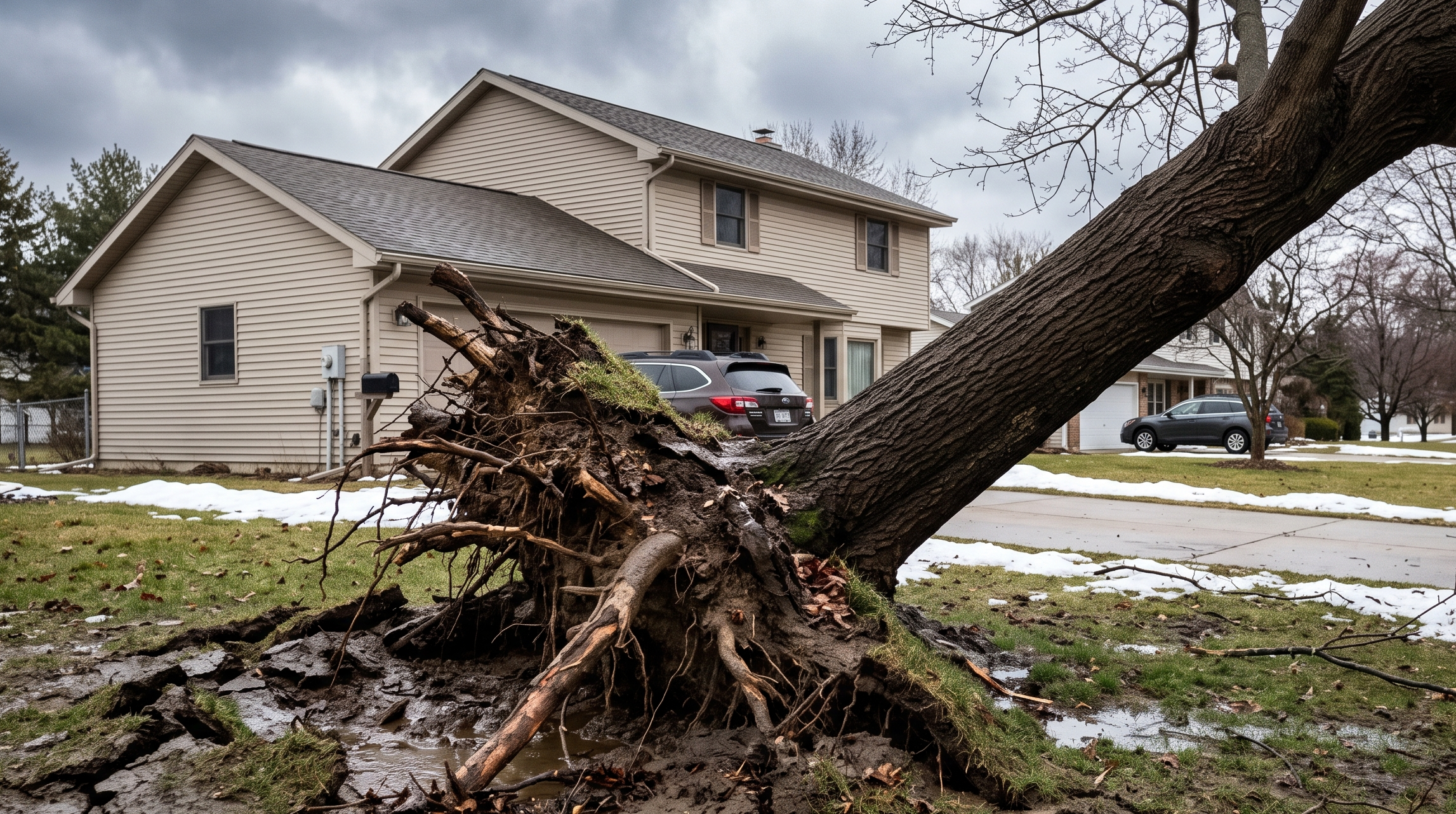
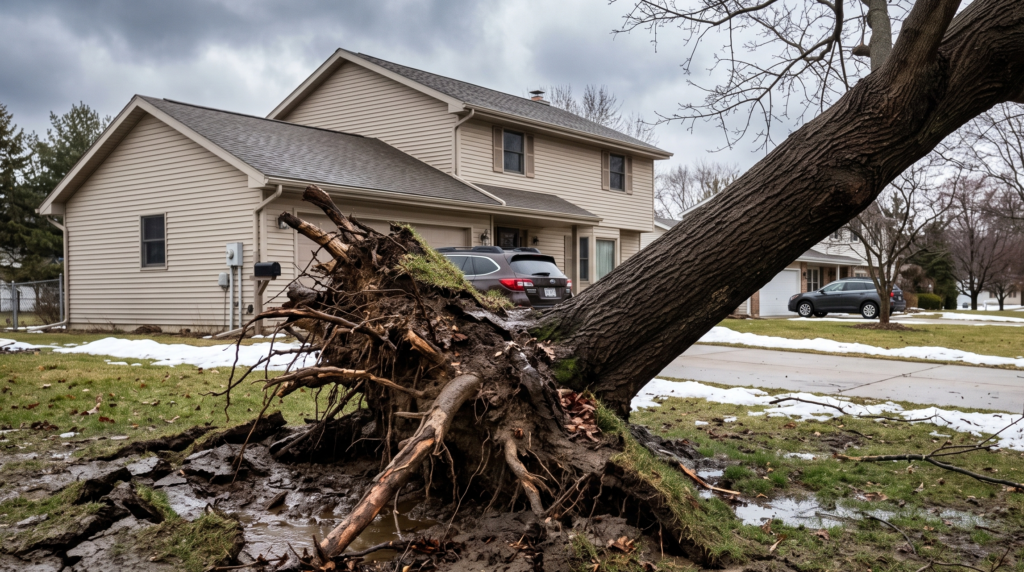
When winter snowpacks collapse into sudden warm rains, the early spring thaw creates severe root instability across residential yards, turning firm ground into muddy slurry and leaving saturated soil that directly causes leaning trees. At JensenStar Tree Company, our ISA-certified arborists evaluate hundreds of waterlogged root zones across Western New York every season. Mature shade trees, evergreen privacy screens, and ornamental landscape specimens that stood plumb for decades suddenly tilt sideways once subsoils liquify. If you walk outside after a rapid snowmelt and notice fresh cracks radiating through wet turf, soil mounding on one side of a tree trunk, or an unmistakable tilt toward your roofline, you are witnessing the mechanical failure of an oversaturated root zone.
Understanding the direct relationship between excessive moisture, structural soil mechanics, and lateral root plate shear is vital for preventing catastrophic property damage and preserving your landscape’s canopy. This guide covers the physical science behind mud-induced tree leans, details how to distinguish cosmetic trunk sweeps from emergency root shears, explains municipal and utility response protocols, and provides a clear triage roadmap to protect your property.
Frequently Asked Questions
Why are leaning trees so much more common during early spring than in mid-summer?
Early spring brings a rapid combination of thawing frozen ground and heavy seasonal precipitation while deciduous trees remain dormant. In summer, warm temperatures and fully leafed-out canopies transpire hundreds of gallons of groundwater daily, drying the soil. In early spring, dormant trees pull negligible moisture from the ground, leaving the root zone waterlogged, mechanically weak, and unable to resist wind leverage.
Can an established tree handle saturated soil for several days without falling?
Most healthy trees can tolerate temporary saturation without failing, provided there are no heavy winds and the root plate remains intact. The danger occurs when high sustained winds or heavy wind gusts strike a canopy while the soil is completely waterlogged, turning the root plate into a lever that tears through muddy ground.
The Physics of Soil Liquefaction & Root Anchor Failure
To understand why a multi-ton oak, maple, or spruce suddenly tilts during a spring warm-up, it is necessary to examine the subsurface root architecture. Contrary to the widespread myth that trees mirror their top branches with a deep downward mirror image of roots, over 85% of a tree’s root system lives in the top 18 to 24 inches of soil. These structural roots spread horizontally two to three times the width of the branch canopy.
A tree’s structural stability depends on a balance known as the root plate anchorage model:
- Tensile Resistance: The roots on the windward side (the side opposite the direction of wind or gravitational lean) are pulled upward under high tension.
- Compressive Resistance: The roots on the leeward or leaning side are pushed downward into the soil substrate, requiring the ground underneath to bear that heavy downward load.
- Soil Shear Strength: The frictional grip of dense, compacted mineral soil holding onto the rough bark and branching network of the root system.
Under normal conditions, mechanical load moves through a predictable chain of force. Lateral wind or gravity presses against the crown, which acts as a tall lever arm. That leverage transfers down the trunk to the base. The roots on the tension side pull against the ground, while the roots on the compression side press into the dirt. As long as the soil’s internal shear friction exceeds the rotational force applied by the trunk, the tree remains upright.
What Happens During the Spring Thaw?
During peak winter, sub-freezing weather locks moisture into crystalline ice, effectively freezing the root plate in place. However, when spring brings temperatures in the 50s and 60s alongside driving rain, the ground thaws from the surface downward.
This process introduces three distinct soil mechanics problems:
- The Perched Water Table: The top 12 inches of topsoil thaw into liquid mud, while the deeper subsoil or hardpan remains cold, dense, or partially frozen. Because gravitational drainage is blocked by the frozen or dense layer beneath, water pools directly in the top 18 inches—the exact depth where the tree’s structural anchor roots reside.
- Loss of Soil Cohesion (Hydrostatic Pore Pressure): Soil particles stick together through friction and capillary suction. When rainfall completely fills the open pore spaces between silt and clay particles, water pressure forces those grains apart. The internal friction of the soil drops close to zero, turning what was once solid ground into a heavy liquid slurry.
- The Mud-Slip Effect: When spring winds hit the canopy, the tension-side roots pull upward. Instead of finding firm earth to brace against, they slide effortlessly through the soupy, liquefied mud. At the same time, the compression-side roots sink downward into the soft mud rather than resting on firm ground. Without lateral soil shear strength, the root ball tilts, causing the tree to lean.
Frequently Asked Questions
What is soil liquefaction in an everyday residential lawn?
In a residential yard, liquefaction occurs when water completely saturates the spaces between soil particles to the point where the soil behaves like a liquid rather than a solid. Under the weight and sway of a multi-ton tree, the mud simply displaces, allowing the root system to rotate out of place.
Does clay soil or sandy soil fail faster during a thaw?
Both fail, but for different reasons. Sandy soil drains faster, but it lacks cohesive strength; when fully saturated, it washes out or loses friction rapidly. Clay soil has high cohesion when dry, but it holds onto standing water for days or weeks, creating a persistent, slippery, perched water table that prolongs the period of root instability.
Early Warning Signs: Root Shear vs. Phototropism
Not every curved or leaning tree is an active emergency. Trees frequently grow with natural curves or gentle trunk sweeps due to phototropism (growing toward open sunlight) or competing adjacent canopies. However, knowing the difference between natural growth habits and active mechanical root failure can save your home from a catastrophic collapse.
| Visual Indicator | Natural Growth / Phototropism | Active Spring Root Failure |
| Trunk Profile | Curved or sweep-shaped; the lower trunk may tilt, but the upper leader curves back straight toward vertical light. | Dead straight trunk leaning at an unnatural angle from the very base of the soil line. |
| Soil Line & Root Plate | Flat, undisturbed soil; lawn and turfgrass remain intact and firmly knitted around the root collar. | Raised mound of soil on the side opposite the lean (soil heaving); sunken depression on the compression side. |
| Root Integrity | No exposed, freshly snapped roots; bark around root flare is intact and weathered evenly. | Snapped anchor roots visible through cracked turf; fresh white wood or broken root tips exposed to air. |
| Tension Cracks | Absent. | Crescent-shaped or radial fissures appearing in the soil 3 to 10 feet out from the trunk. |
| Timing of Movement | Develops over years and decades as the tree seeks unobstructed sunlight. | Appears suddenly—overnight or over a 48-hour period following rapid snowmelt or heavy rainfall. |
Inspecting the Root Flare
The root flare—the wide area where the trunk transitions into the main structural surface roots—provides the most accurate diagnostic evidence for homeowners. Perform a close visual check around the perimeter of the trunk base:
- Tension-Side Soil Heaving: Walk to the side directly opposite the lean. Look for turf that looks pushed upward, like a trapdoor opening slightly. If the grass is stretched, torn, or lifted above the surrounding grade, the root plate has peeled away from the subsoil.
- Probing for Subterranean Voids: Take a long metal soil probe or long screwdriver and gently push it into the ground near the base of the lifted side. If the tool drops several inches or feet into an open cavity beneath the root ball without resistance, the roots have pulled completely out of their subterranean anchor bed.
- Bark Shearing at Ground Level: Sudden shifting tears the delicate vascular tissue at the base of the trunk. Look for vertical splits, crushed bark, or weeping sap near the root collar.
Frequently Asked Questions
How can I tell if my tree just started leaning or if it has always been that way?
Look closely at the soil around the base and the direction of the top branches. If the ground is cracked, mounded, or soft on one side, the lean is new. Furthermore, if the tree trunk is dead straight all the way to the top tip while leaning, the shift happened recently. If the tree leaned years ago, the top branches and leader would have curved upward toward the sky.
Can a tree lean without any visible cracks in the lawn?
Yes. In very deep, wet silt or loose sandy soils, the root ball can rotate smoothly through the slurry without tearing the elastic carpet of turf on top. If the trunk angle looks different after a storm, check the plumb line against a fixed reference point, such as the corner of your home or garage.
Tree Species Most Susceptible to Mud-Induced Leans
While any tree can fall if the ground turns to pure liquid, differences in root architecture, wood density, and winter foliage make certain species far more vulnerable to spring failure.
Species with a dominant central taproot or deep, downward sinker roots—such as white oaks, bur oaks, shagbark hickories, and black walnuts—anchor deep below seasonal frost and thaw zones, giving them exceptional resistance to spring heave. In contrast, species that produce wide, shallow, fibrous root plates that sit almost entirely in the top two feet of soil have a much higher risk of tilting when those surface layers turn to mud.
1. Shallow-Rooted Surface Feeders
- Norway & Colorado Blue Spruces (Picea species): Spruces naturally produce very shallow, flat root plates that sit in the top 12 to 18 inches of soil. Because they are evergreens, they keep their needles through the winter. When early spring storms drop wet, heavy snow followed by rain and high winds, the dense foliage catches the wind like a sail while the shallow root plate sits in waterlogged mud.
- Silver Maples (Acer saccharinum): Silver maples grow rapidly and produce expansive, aggressive surface root systems. Their wood is relatively light and brittle, and their crowns tend to grow wide and heavy. When spring rains dissolve soil friction, the off-center weight of their massive limbs readily tips the root plate.
- Willows (Salix species): Willows thrive in wet soils near drainage ways and ponds, but their root structures are fibrous rather than deep. In seasons with prolonged runoff, the ground can become so saturated that it offers zero lateral resistance against their broad, spreading canopies.
2. Dense Evergreen Conifers
- Eastern White Pines (Pinus strobus): White pines feature soft wood and large, sweeping branches that hold heavy amounts of rain and snow. When spring winds blow through a thawed yard, the leverage exerted by an 80-foot white pine on saturated soil can easily shear its surface roots.
- Arborvitae Privacy Screens (Thuja occidentalis): Widely planted along property lines and fence rows, arborvitae hedges are frequently installed in excavated trenches where soil is disturbed or poorly drained. Because they are grown closely together as a solid green wall, a wind gust strikes the entire hedge at once, often causing an entire row to lean together in soft spring soil.
3. Fast-Growing Landscape Ornamentals
- Callery / Bradford Pears (Pyrus calleryana): These ubiquitous ornamental trees are notorious for dense, heavy canopies and poor branch angles that catch wind. When the root zone softens in spring, their top-heavy structural imbalance easily overpowers their shallow root systems.
Frequently Asked Questions
Do taproot trees ever lean or fall during a spring thaw?
It is rare for a healthy, mature taproot tree (like an oak or hickory) to lean purely from saturated soil, because their primary anchor roots penetrate deep into stable, unsaturated subsoils. However, if the tree’s deep roots have rotted from chronic poor drainage, or if construction severed them in the past, even an oak can fail in a thaw.
Are newly planted saplings at greater risk than mature trees?
Yes, newly planted trees (those in the ground less than two years) have not grown anchoring roots into the surrounding native soil. Their root ball is still confined to the original nursery hole, which can act like a bucket holding water, making them very easy to tilt in high winds.
When Can a Leaning Tree Be Saved? (The 15-Degree Rule)
When faced with a leaning tree, many homeowners ask if the tree can simply be pulled back upright with a winch and staked. The answer depends on tree age, trunk diameter, root damage severity, and the angle of lean.
Arborists generally look at the angle of tilt as a baseline:
- Leans Between 1 and 14 Degrees: For young, flexible trees with minimal root breakage, corrective staking and soil remediation may allow the tree to recover.
- Leans of 15 Degrees or Greater: A lean past 15 degrees typically indicates major structural root severance. For large or mature trees, this represents catastrophic failure, requiring safe removal rather than mechanical re-righting.
Candidates for Straightening and Staking
A leaning tree may potentially be preserved if it meets all of the following criteria:
- The tree is young or recently planted, with a trunk diameter of less than 4 to 5 inches.
- The lean is under 15 degrees off vertical plumb.
- The main structural roots are intact and pliable, meaning the root ball slipped within the mud rather than snapping in half.
- The tree belongs to a species known for vigorous root regeneration, such as young elms, red maples, or river birches.
Never attempt to winch a large, mature tree back upright. Pulling an established root plate tears any remaining intact anchor roots. Even if the tree appears straight afterward, its structural foundation is broken, creating an invisible fall hazard that could come down months later in a summer thunderstorm.
Situations Requiring Immediate Removal
A leaning tree must be condemned and safely removed by a professional crew when:
- The tree is mature, with a trunk diameter exceeding 8 to 10 inches.
- The lean exceeds 15 degrees or is visibly increasing from day to day.
- Thick primary anchor roots (2 inches or wider) are visibly broken or sticking out of the ground.
- The tree leans toward valuable targets, such as homes, driveways, garages, public sidewalks, or overhead power lines.
- The trunk or root flare shows pre-existing decay, hollow cavities, or fungal conks (bracket mushrooms).
Frequently Asked Questions
Can I pull my leaning tree straight using my pickup truck or an ATV?
No. Using a vehicle or winch to pull a leaning tree is dangerous. It frequently snaps the remaining roots, tears the bark around the trunk, or causes the tree to bounce back uncontrollably, creating an extreme safety hazard for anyone nearby.
If we stake a young tree back up after a spring lean, how long must the stakes stay on?
Stakes and guy lines on a re-straightened young tree should generally remain in place for one full growing season—from spring through late autumn. This allows the tree to grow a new network of fine and woody roots to anchor itself before winter returns.
Step-by-Step Emergency Protocol for Property Owners
Discovering a mature tree leaning toward your home or across your driveway is stressful. Following a clear, systematic emergency response plan helps keep your family safe and prevents costly property damage.
The five critical emergency steps are
- Secure the Ground Perimeter: Keep all people, children, and pets well beyond the potential fall zone.
- Inspect for Overhead Utilities: Determine whether the trunk or branches are touching live electrical or communication wires.
- Clear Moveable Targets: Move cars, outdoor furniture, and personal items away from the fall path.
- Document the Damage: Take detailed, time-stamped photos of the lean and the ground for insurance records.
- Call a Certified Arborist: Bring in a licensed, insured tree care team with crane and rigging capabilities.
Step 1: Secure the Zone Immediately
Establish an exclusion perimeter equal to at least 1.5 times the total height of the tree in all directions. Saturated ground can give way without warning, causing a tree to fall with tremendous force. Do not allow anyone to walk under or near the leaning side of the tree.
Step 2: Check for Utility Wire Hazards
Carefully scan the tree’s branches and trunk from a safe distance:
- If the tree or any snapped branches are touching power lines, stay far away. Wet wood and saturated ground conduct electricity.
- Call your local electric utility provider’s emergency dispatch line and dial 911 immediately.
- Do not touch metal fences, downspouts, or outbuildings near an electrically charged tree.
Step 3: Evacuate Targets from the Impact Arc
- Move all cars, trailers, and outdoor equipment out of the driveway or yard if they sit within the potential fall zone.
- If a large tree is leaning steeply toward an occupied home, avoid using the rooms directly in its path until a professional can evaluate the tree’s stability.
Step 4: Document the Condition for Insurance
Before any emergency crew begins cutting limbs, take clear photos and videos from multiple angles:
- Capture wide-angle shots showing the entire tree, its angle of lean, and its proximity to your home or structures.
- Take close-up photos of the ground at the tree’s base, highlighting mounded soil, exposed roots, and standing water.
- Photograph any existing damage to fences, gutters, siding, or roofing.
Step 5: Contact a Fully Insured, ISA-Certified Arborist
Emergency tree work in waterlogged conditions requires specialized commercial equipment:
- Ground Protection Mats: Heavy composite mats (such as AlturnaMATS) are laid across your yard so heavy service trucks and knuckle-boom cranes can operate without destroying your lawn or getting stuck in the mud.
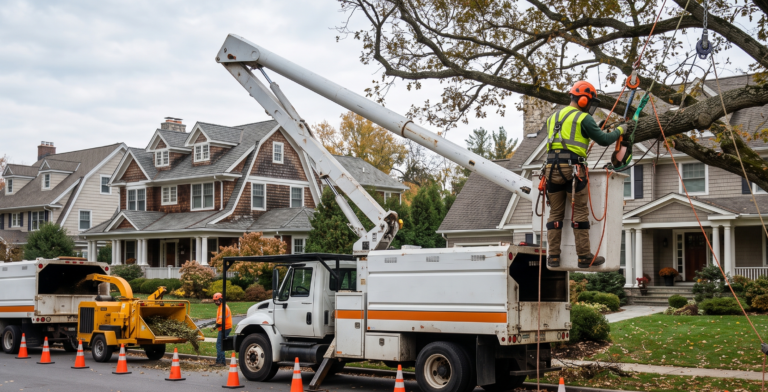
- Crane-Assisted Removals: Cranes allow arborists to lift large, heavy sections of wood vertically into the air, removing the weight without letting the unstable root ball shift or tip further.
Frequently Asked Questions
Who pays if my neighbor’s tree leans over my property line after a thaw?
In most jurisdictions, you have the legal right to trim branches that overhang your property line up to the boundary, provided you do not damage the health of the tree. However, if a neighbor’s tree is leaning dangerously and presents an imminent threat, you should notify them in writing. immediately. Once put on notice of a hazardous condition, the tree owner may be held liable for damages if it falls.
Will homeowners insurance pay to remove a leaning tree before it hits anything?
Standard homeowners insurance policies rarely pay to remove a tree that is merely leaning, as insurance covers sudden, accidental property damage rather than preventative maintenance. However, if the tree has fallen and damaged a covered structure, removal costs are generally included up to policy limits. Check your specific policy terms with your insurance provider.
Long-Term Prevention: Drainage, Mulch, & Canopy Management
While you cannot stop seasonal rains or winter snowmelts, sensible landscape management can protect your soil structure and root health against future thaw events.
An effective prevention strategy relies on three main practices:
- Engineered Subsurface Drainage: Redirecting surface runoff, extending downspouts, and relieving soil compaction to keep water moving away from the root flare.
- Proper Organic Mulch Management: Applying natural wood chips at the correct depth while avoiding harmful mulch volcanoes.
- Canopy Management & Pruning: Thinning dense branches to reduce the wind-sail effect and shortening overextended limbs to reduce mechanical leverage.
1. Engineered Drainage and Water Redirection
Water should never sit stagnant around a tree’s root collar for days on end:
- Extend Downspouts: Make sure roof downspouts discharge water at least 10 to 15 feet away from the base of valuable yard trees. Dumping roof runoff directly onto a tree’s root zone guarantees soft, unstable soil every spring.
- Install Swales or French Drains: If your property slopes downward toward your trees, consider installing gravel-lined swales or perforated French drain pipes to catch surface runoff and route it to an appropriate drainage basin.
- Pneumatic Soil Decompaction (AirSpade Work): High-traffic lawns often suffer from severe soil compaction, which prevents water from sinking into deeper layers. Professional arborists use pneumatic air tools to fracture dense clay without cutting roots, creating channels for drainage and root growth.
2. Mulch Wisely
Mulch is an outstanding tool for stabilizing soil moisture, but it must be applied properly:
- The Right Way: Spread a 2- to 4-inch layer of natural, aged wood chips across the root zone out to the dripline. This mulch layer acts like a sponge, absorbing heavy spring precipitation and preventing soil erosion.
- The Wrong Way (Mulch Volcanoes): Never pile mulch directly against the tree trunk. Trapped moisture against the bark suffocates the root flare and invites fungal pathogens like Armillaria and Phytophthora, which rot the anchor roots and make the tree far more likely to lean.
3. Structural Canopy Pruning
The wind load on the crown provides the physical force that pushes a waterlogged tree over.
- Crown Thinning: A certified arborist can selectively prune secondary branches to allow strong winds to pass cleanly through the crown rather than acting like a sail.
- Weight Reduction: Trimming back heavy, overextended limbs lightens the load on the trunk and reduces the pulling force exerted on the root plate during early spring gusts.
Frequently Asked Questions
How deep should arborist mulch be around mature shade trees?
Maintain a consistent depth of 2 to 4 inches. Applying more than 4 inches of mulch can restrict oxygen exchange to the root system and create an overly wet environment that encourages fungal root rot.
Can deep-root fertilization help prevent trees from leaning?
Fertilization does not directly anchor a tree. However, prescription soil injections that balance soil chemistry, relieve compaction, and stimulate mycorrhizal root development help the tree grow a denser, stronger root network that provides better stability over time.
Finding an Emergency Tree Service Near Me During the Spring Thaw
When lake-effect snowbanks melt rapidly and merge with torrential early-spring rainstorms across Western New York, searches for a dependable tree service near me surge overnight. Properties throughout Erie County—especially those set on dense lacustrine clay soils in Amherst, Cheektowaga, West Seneca, and Orchard Park, as well as wind-exposed lakefront lots in Hamburg and Grand Island—experience high hydrostatic ground saturation that compromises root plates every year.
Selecting a local tree care specialist near your property is critical when ground stability gives way:
- Regional Soil Knowledge: Glacial clay deposits across Tonawanda, Kenmore, and Clarence retain perched moisture for weeks longer than sandy loam profiles near the Niagara River. When saturated, this heavy clay acts as a lubricant beneath shallow root plates, drastically increasing failure rates during March and April wind events.
- Rapid-Response Emergency Dispatch: If a 70-foot spruce or silver maple starts tilting toward your roofline in North Buffalo, South Buffalo, or Williamsville, transit times are vital. JensenStar Tree Company dispatches certified crews outfitted with heavy composite turf-protection mats, enabling crane-assisted removals without turning saturated residential lawns into deep mud trenches.
- Coordinated Utility Protocols: Trees leaning across private property lines frequently interfere with primary overhead service drops. Our arborists work directly with regional power utilities such as National Grid and NYSEG to confirm power shutdowns before rigging unstable trunks off structures.
Frequently Asked Questions
How fast can a local emergency tree service arrive at my Erie County home?
JensenStar Tree Company operates dedicated emergency crews on standby throughout the spring thaw, typically arriving on-site within 1 to 3 hours across Buffalo and surrounding suburbs to inspect structural stability, establish drop perimeters, and prevent structural collapse.
Do you charge for on-site structural tree inspections in the Buffalo metro area?
No. JensenStar Tree Company provides comprehensive on-site hazard evaluations across Erie County to determine whether a leaning tree can be secured via cabling and bracing or requires immediate, crane-assisted extraction.
Professional Tree Risk Assessment & Emergency Services
A leaning tree following a rapid spring thaw is an urgent structural emergency that should never be ignored. When waterlogged ground gives way, a tree’s balance can shift completely in minutes. Taking a proactive approach—inspecting the root flare, verifying downspout discharge paths, and scheduling regular hazard evaluations with an ISA-certified arborist—ensures your landscape remains safe and sound through unpredictable seasonal weather.
If you observe soil heaving, cracked ground, or an active lean on your property, turn to the licensed and insured specialists at JensenStar Tree Company. Our team uses modern diagnostic tools, including sonic tomography and AirSpade pneumatic root exposure, to assess hidden decay and restore safety to your yard.
- Primary Phone: (716) 703-5666
- Website: https://companyjensenstartree.com/
- Service Area: Buffalo, Amherst, Cheektowaga, Tonawanda, West Seneca, Hamburg, Clarence, Orchard Park, and surrounding Western New York communities.
- Credentials: ISA-Certified Arborists, Fully Insured Commercial General Liability, ANSI A300 Pruning Standards Compliant.