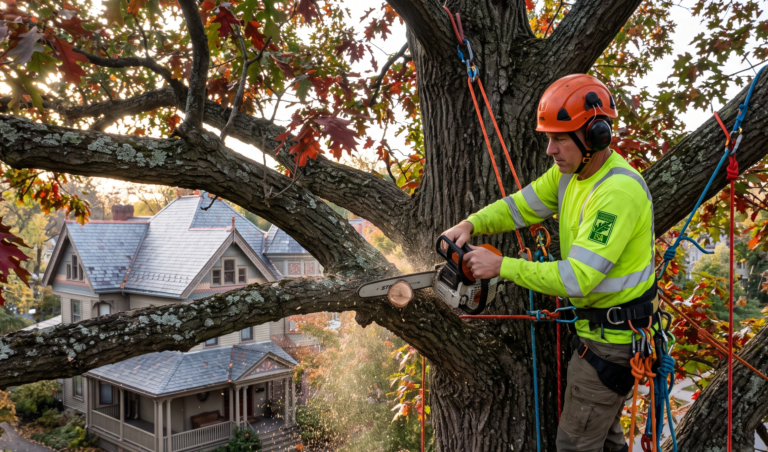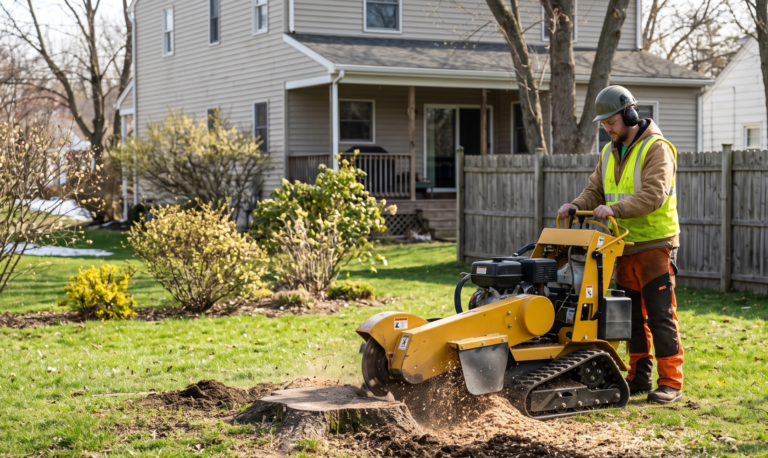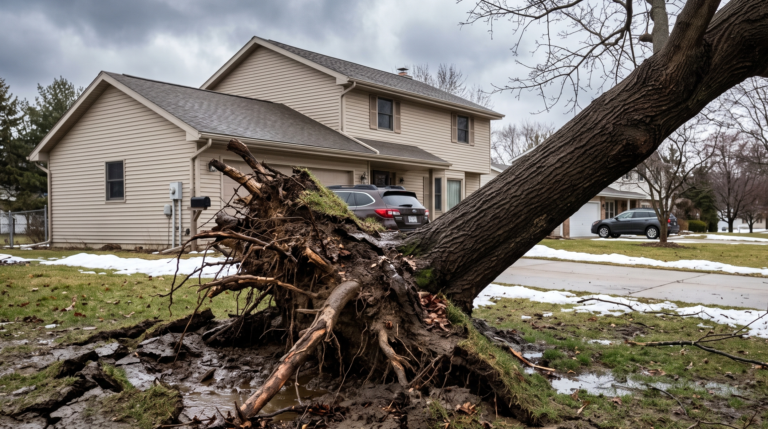

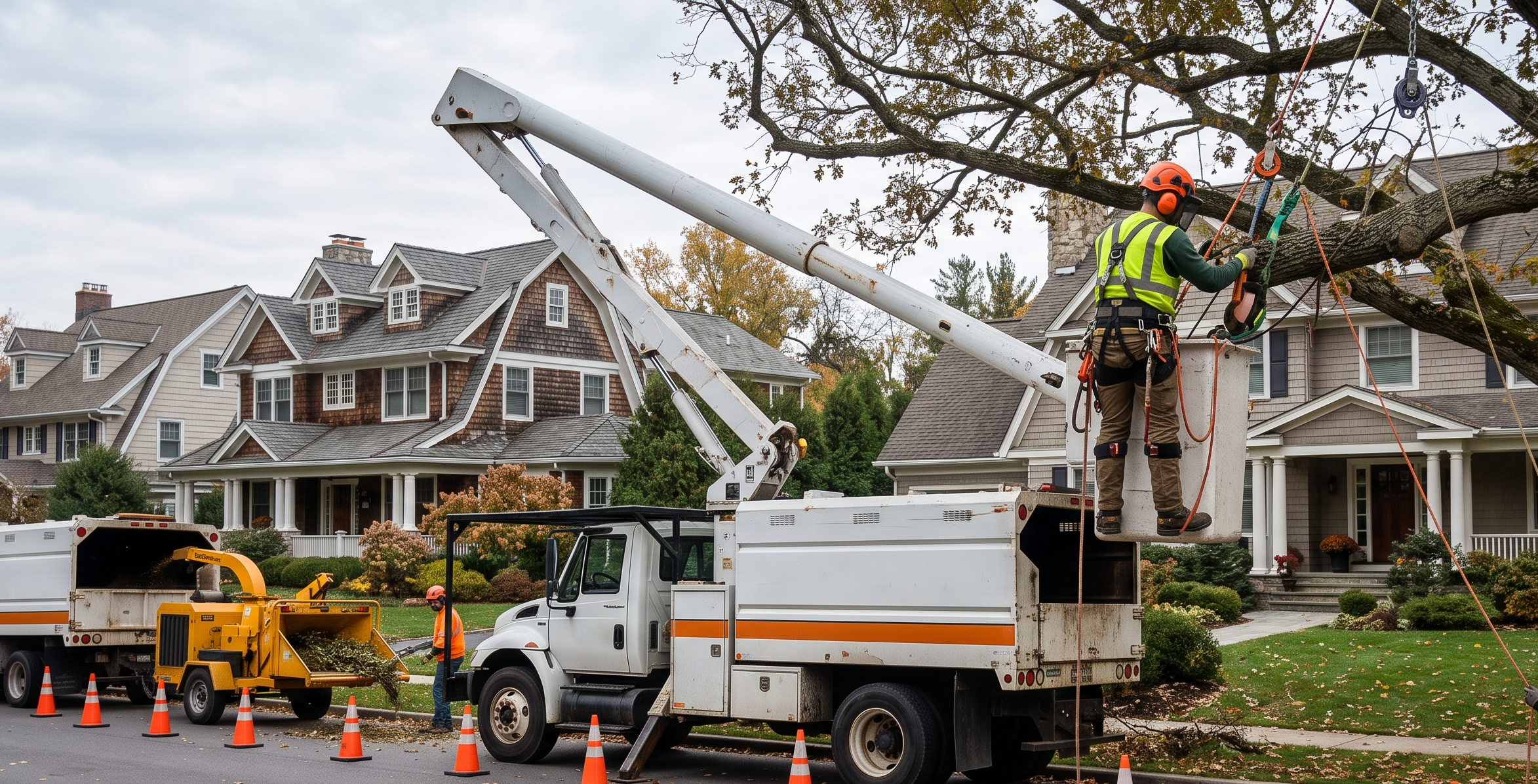
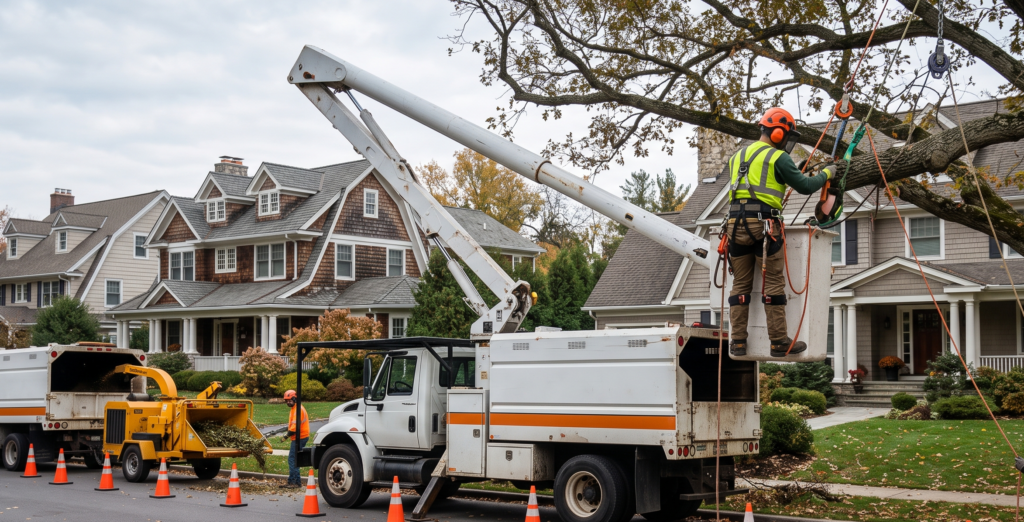
When managing residential or commercial real estate in Western New York, securing proper tree removal permits in Erie County across Buffalo, Amherst, and Cheektowaga is an essential legal and safety protocol before bringing out chainsaws, bucket trucks, or cranes. Municipal rules in Erie County differ significantly depending on whether a tree stands on private residential land, within a dedicated public right-of-way, or across commercially zoned acreage. At Jensen Star Tree, our ISA-credentialed arborists work daily with regional building departments, code enforcement officers, and homeowners to keep projects fully compliant, insured, and safe.
Navigating municipal bylaws requires clear distinction between where city property lines end, where suburban town building codes apply, and what administrative documentation is required before felling mature hardwoods, diseased ash, or storm-damaged maples.
Erie County Tree Regulations: An Overview
Erie County does not operate under a single, unified countywide tree removal ordinance for private property owners. Instead, New York State grants home-rule authority directly to individual cities, towns, and incorporated villages. Consequently, a homeowner living on a 50-foot residential lot in South Buffalo answers to a completely different regulatory framework than a homeowner on a two-acre parcel along Transit Road in Amherst or an industrial facility manager in Cheektowaga.
Knowing which authority governs your tax parcel protects you from costly stop-work orders, code violation summonses, and civil fines.
| Factor | City of Buffalo | Town of Amherst | Town of Cheektowaga |
| Primary Governing Body | Department of Public Works (Parks & Forestry) | Building Dept. & Highway Dept. | Building & Permitting Department |
| Private Residential (< 1 Acre) | Generally exempt (outside historic zones) | Generally exempt for standard single-family lots | Tree Removal Permit Application required |
| Public Right-of-Way / Street Trees | Mandatory DPW Permit; licensed contractor only | Town Highway Department jurisdiction | Town Highway/Engineering jurisdiction |
| Parcels > 1 Acre or Undeveloped Land | Site plan & zoning board environmental review | Mandatory permit for trees 4″ caliper | Comprehensive building department review |
| Emergency Tree Hazard Exception | Immediate action allowed; document arborist hazard. | Retroactive notice allowed with proof of failure | Retroactive notice allowed with clear photo evidence |
Frequently Asked Questions
Does the Erie County government handle tree permits for private residential yards?
No. Erie County administration does not process or issue tree removal permits on private land. All oversight is delegated to local city halls, town offices, or village boards.
Can an incorporated village have different rules than its surrounding town?
Yes. Incorporated villages (such as the Village of Williamsville inside Amherst or the Village of Sloan inside Cheektowaga) enforce independent zoning codes and landscape preservation ordinances that supersede town-level rules within village limits.
What is the legal definition of “tree caliper” in local Western New York codes?
“Caliper” refers to the trunk diameter. In standard municipal arboriculture, the caliper is measured 6 inches above the root flare for smaller nursery stock or at 4.5 feet above grade (Diameter at Breast Height, or DBH) for mature specimen trees.
1. City of Buffalo: Urban Forestry and Right-of-Way Rules
Buffalo maintains one of the most historically significant urban canopies in the United States, shaped by Frederick Law Olmsted’s classic parkway systems. Because of this architectural heritage, municipal authorities maintain strict oversight over public trees while balancing private property rights.
Private Property Rules in Buffalo
For standard residential property owners in neighborhoods such as North Buffalo, Elmwood Village, South Buffalo, the Old First Ward, or the West Side, a municipal permit is generally not required to cut down a tree located entirely on private land.
Important regulatory exceptions apply:
- Historic Preservation Districts: If your property is within a designated local historic preservation district (such as the Allentown Historic District or Delaware Historic District), significant exterior landscape alterations may require an advisory or binding review from the Buffalo Preservation Board.
- Buffalo Green Code Compliance: Vacant lot clearing, multi-family construction, and commercial developments require formal site plan approval. This process requires tree inventories, canopy replacement calculations, and tree protection fencing during excavation.
Public Right-of-Way and Street Trees
Buffalo strictly regulates trees situated on the “tree lawn”—the municipal strip between the public sidewalk and the road curb.
- Permit Requirement: You must submit a formal DPW Tree Work Permit through the City of Buffalo Department of Public Works, Parks and Recreation (Bureau of Forestry), prior to removing, pruning, or planting any street tree.
- Lead Time: Applications must be submitted at least 30 days prior to any planned mechanical work.
- Mandatory Contractor Qualifications: The contractor performing the work must hold an active City of Buffalo Tree Contractor License, maintaining proof of comprehensive general liability insurance and statutory NYS workers’ compensation coverage.
- Permit Fee: The City of Buffalo does not charge a filing fee for the DPW Tree Work Permit.
Frequently Asked Questions
Can I cut down a street tree in Buffalo if its roots are lifting my sidewalk?
No. Street trees are municipal property. Cutting or damaging a city street tree without an approved DPW permit is illegal. You must request a forestry assessment through Buffalo 311 or submit a formal DPW Tree Work Permit application.
How can I verify if my Buffalo property falls within a designated historic district?
Check your address against the City of Buffalo Office of Historic Preservation maps or search the parcel’s zoning classification in the online Buffalo Green Code portal.
What insurance is required for tree work within Buffalo city limits?
Tree care contractors working within public rights-of-way must supply a Certificate of Insurance listing the City of Buffalo as an additional insured, carrying at least $1,000,000 in general liability alongside New York State Workers’ Compensation (Form C-105.2 or U-26.3).
2. Town of Amherst: Acreage and Undeveloped Parcel Standards
As Erie County’s most populated suburban township—covering Snyder, Eggertsville, East Amherst, and the borders of Williamsville—Amherst balances residential safety against rapid commercial and residential land development.
Standard Residential Lots vs. Large Acreage
The Town of Amherst Building Department distinguishes rules based on parcel acreage and development status:
- Single-Family Residential Lots (Under 1 Acre): If you own an established single-family home on an individual lot under one acre, you do not need a town permit to remove dead, diseased, or unwanted trees from private ground outside of conservation easements.
- Parcels Over 1 Acre and Undeveloped Land: Amherst mandates a formal Tree Removal Permit for any property exceeding one acre in total size or any vacant, undeveloped parcel undergoing preparation.
- The 4-Inch Caliper Rule: On these larger or undeveloped parcels, cutting any healthy, living tree measuring 4 inches in caliper or greater without prior town review and an approved landscape conservation plan is a direct violation of town code.
Town Right-of-Way and Street Trees
Street trees in Amherst subdivisions are overseen by the Amherst Highway Department (Tree/Parks Division).
- Homeowners cannot remove or top town-owned street trees due to driveway or sidewalk issues.
- Town policy dictates that removals are authorized only if a tree is dead, structurally hazardous, or severely diseased.
- If a street tree appears compromised, residents should schedule a town assessment rather than hiring an unauthorized crew.
Frequently Asked Questions
Does a homeowner on a half-acre lot in Snyder need a town permit to remove a spruce tree?
No. Routine residential parcels under one acre are exempt from Amherst’s formal tree permit, as long as the tree is located entirely within private property lines and outside designated wetland or drainage buffers.
What are the consequences of unauthorized clearing on large Amherst properties?
Clearing trees 4 inches in caliper or larger on parcels over one acre without an approved permit can result in immediate stop-work orders, municipal court summonses, per-tree fines, and mandatory replanting orders.
Who handles tree limbs hanging from an Amherst Street tree over my private driveway?
The Amherst Highway Department manages street tree maintenance. You should submit a service request directly through the Highway Department to have the town crew or an authorized contractor elevate the canopy.
3. Town of Cheektowaga: Comprehensive Permitting Oversight
Cheektowaga—home to densely populated neighborhoods including Cleveland Hill, Bellevue, and Pine Hill—takes an active approach toward regulating its urban forest to safeguard drainage and community character.
Town-Wide Permitting Requirements
Unlike neighboring towns that restrict permit requirements primarily to large acreages, Cheektowaga’s Building and Permitting Department maintains a dedicated Tree Removal Permit Application process that applies across residential zones.
- Permit Application: Property owners must file an application detailing tree species, trunk diameter, property position, reason for removal, and whether the tree presents a hazard to primary buildings, utility runs, or adjacent properties.
- Inspector Review: The town supervising code enforcement officer reviews submissions to confirm that removals do not compromise stormwater mitigation easements, shared utility corridors, or required site buffers.
- Contractor Documentation: Commercial felling operations mandate documented contractor credentials, proof of insurance, crane safety plans, and clear debris disposal protocols.
Street and Easement Trees in Cheektowaga
Cheektowaga manages broad municipal easements along roads, drainage ditches, and culverts. Trees rooted within these easements fall under town jurisdiction. Removing an easement tree without town authorization violates municipal property maintenance laws.
Frequently Asked Questions
Where do I pick up a tree removal permit application in Cheektowaga?
Applications are available through the Town of Cheektowaga Building and Permitting Department at Town Hall (3301 Broadway) or downloadable directly from the town’s official online portal.
Why does Cheektowaga require permits on standard residential properties?
Due to high regional water tables and dense clay soils, Cheektowaga monitors tree removal to protect natural stormwater absorption, prevent localized yard flooding, and preserve neighborhood windbreaks.
Can Cheektowaga code officials deny a tree removal application?
Yes. If an arborist or town inspector finds that a tree is healthy, structurally sound, and serves as an integral drainage or landscape buffer, the permit application may be denied or require replanting alternatives.
Technical Tree Evaluations: Why Municipalities Intervene
Why do towns like Amherst and Cheektowaga regulate tree removals while Buffalo focuses primarily on street trees and historic areas? The answer lies in civil engineering, stormwater management, and regional biology.
1. Lake-Effect Precipitation and Heavy Clay Soils
Western New York experiences heavy lake-effect snowfalls, freezing ice storms, and high wind events off Lake Erie. Unregulated clear-cutting causes immediate hydrologic issues. Mature maples and oaks absorb hundreds of gallons of water daily during peak growing periods. When extensive tree cover is removed over dense Erie County clay soils, local water tables rise, often aggravating foundation moisture, sump pump failures, and municipal stormwater overload.
2. Emerald Ash Borer (EAB) Structural Degradation
Erie County has seen extensive loss of green and white ash populations due to the Emerald Ash Borer (Agrilus planipennis). As larval feeding destroys vascular cambium tissues, dead ash trees become exceptionally brittle. Their structural wood snaps under light tension without warning. Municipalities often prioritize and expedite removal permits for infested ash to prevent canopy failures over streets and pedestrian walkways.
3. High-Voltage Utility Clearances
Trees growing near electrical distribution infrastructure present severe public hazards. Felling trees without verified drop plans risks taking down high-voltage wires, causing neighborhood outages and substantial repair liabilities. Municipalities routinely require proof of utility coordination with National Grid or NYSEG before issuing tree work authorizations near major rights-of-way.
Frequently Asked Questions
Why are Emerald Ash Borer-infested trees especially hazardous to fall?
Infested ash wood dries out quickly and loses structural flexibility. Limbs and upper trunks often shatter during felling rather than hinging predictably, requiring bucket trucks or specialized crane-assisted rigging to remove safely.
How does mature tree removal impact residential yard drainage?
A single mature hardwood can transpire over 100 gallons of moisture daily during the summer. Removing several mature canopy trees from clay-heavy soil frequently leads to standing water, yard ponding, and extra hydrostatic pressure against home foundations.
Do utility companies charge homeowners to clear limbs near power lines?
National Grid and NYSEG maintain clearances around primary street distribution lines at no cost to the homeowner. However, the service drop running from the roadside utility pole directly to your house weatherhead is private property and must be maintained by an insured private tree service.
Border Trees and New York State Property Law
Boundary disputes over shared trees are common across Erie County’s older, densely settled neighborhoods. Knowing state property law clarifies ownership and liability before scheduling work.
Who Legally Owns the Tree?
- Trunk Position Dictates Ownership: Under New York State common law, ownership of a tree is determined strictly by where the base of the trunk emerges from the ground. If the trunk sits wholly on your neighbor’s parcel, it belongs entirely to your neighbor—even if most of its branches overhang your garage or roof.
- Boundary Line Trees: If the trunk straddles the property boundary line, it is legally defined as a boundary tree held in common tenancy. Neither owner can fall or severely damage the tree without the other’s explicit consent, regardless of municipal permits.
Branch and Root Encroachment Rights
Under New York law, you have the legal right to trim overhanging branches and encroaching root systems up to your property line, provided:
- You do not cross the boundary line onto the neighboring property without permission.
- Your trimming does not destroy the tree’s health or structural stability. Aggressive pruning that kills or destabilizes a neighbor’s tree can leave you liable for treble damages under New York Real Property Actions and Proceedings Law (RPAPL § 861).
Frequently Asked Questions
Can my neighbor force me to cut down a tree because it drops leaves in their yard?
No. Natural shedding of leaves, twigs, and fruit is classified as an ordinary natural occurrence under New York State law. Neighbors cannot legally compel you to cut down a healthy tree because of natural debris.
What should I do if a neighbor’s dead tree threatens my home?
Hire an ISA-certified arborist to complete a written tree hazard assessment. Send that report to your neighbor via certified mail with return receipt requested. This formal notification establishes legal notice of negligence under NY law if the tree subsequently fails and causes damage.
Can I cut encroaching roots that are damaging my concrete driveway?
You may trim roots up to your exact boundary line, but you must avoid severing primary structural anchor roots that would destabilize the tree. Destabilizing a tree that subsequently falls makes you legally liable for resulting property damage.
When Can You Bypass the Standard Permitting Process?
Severe storm events and sudden structural failures sometimes require immediate arborist intervention, bypassing standard municipal waiting periods.
Identifying Legitimate Tree Emergencies
A true tree emergency includes:
- A tree trunk that has split and is resting against a home, garage, or vehicle.
- An uprooted root plate actively lifting municipal sidewalks, foundations, or driveways after an ice or wind storm.
- Large broken limbs hanging directly over high-voltage electrical lines or public roadways.
Protecting Yourself Legally During an Emergency
When urgent hazards demand immediate removal:
- Take Clear Time-Stamped Photos: Capture wide-angle views of the property, close-ups of the fractured wood or uprooted plate, and the proximity to damaged structures.
- Obtain an ISA Arborist Hazard Report: Written documentation from a certified arborist confirming imminent failure risk provides crucial protection against municipal code violations.
- Notify the Town Post-Work: Submit an email or letter to the local building inspector or highway superintendent within 24 to 48 hours explaining the emergency intervention alongside your photo documentation.
Frequently Asked Questions
Can I cut down a tree that falls onto my roof during a storm without waiting for a permit?
Yes. Imminent hazards threatening human safety or structural stability qualify for immediate emergency removal under municipal rules. Be sure to document the site thoroughly with photos before work begins.
How soon after an emergency tree removal should I notify municipal code officers?
Notify your local municipal building or highway department within 24 to 48 hours following emergency work, providing photo records and the contractor’s job report.
Does homeowners insurance cover tree removal in Erie County?
If a fallen tree damages an insured structure (such as a house, detached garage, or fence), policies generally cover removal and debris disposal. If a tree falls safely on an open lawn without damaging structures, removal coverage depends on your specific policy terms and endorsements.
Practical Checklist for Tree Removal in Erie County
To ensure your tree project proceeds safely and compliantly, follow these operational steps:
- Verify Your Municipality: Confirm whether the parcel falls under the City of Buffalo, the Town of Amherst, the Town of Cheektowaga, or an incorporated village like Williamsville or Sloan.
- Review Property Boundaries: Consult your property survey map to determine whether the tree is private, located on a shared boundary line, or in the municipal right-of-way.
- Confirm Permit Needs:
- Buffalo: DPW Tree Work Permit required for street/ROW trees.
- Amherst: Town permit needed for undeveloped parcels or lots over one acre.
- Cheektowaga: Building Department Tree Removal Permit Application required.
- Hire a Qualified, Insured Contractor: Verify that your contractor maintains active general liability and New York State workers’ compensation insurance.
- Submit Municipal Paperwork: Allow 5 to 15 business days for municipal review before scheduling heavy equipment on site.
- Complete the Work Safely: Ensure the crew implements proper drop rigging, utility clearances, stump grinding, and thorough wood disposal.
Frequently Asked Questions
How long does it take for municipal offices in Erie County to process a tree permit?
Permit reviews generally take between 5 and 15 business days, depending on department workload, season, and whether an on-site inspection is required.
Does a tree removal permit cover stump grinding?
Stump grinding is typically evaluated as part of the overall site remediation plan within the original application. Always verify that underground utilities are marked via Dig Safely New York (call 811) before grinding.
Do I need a permit to plant a new tree after a removal?
Planting on private residential land does not require a municipal permit. However, planting within the street right-of-way in Buffalo, Amherst, or Cheektowaga requires forestry department approval to ensure proper species selection and utility spacing.
Reliable Tree Removal Near Me: Serving Buffalo, Amherst, and Cheektowaga
When severe Western New York weather strikes or a compromised tree threatens your home, finding certified tree removal near me requires partnering with a local arborist team that understands municipal permitting, regional clay soils, and tight lot clearances.
Centrally based on Montana Avenue in Buffalo, Jensen Star Tree delivers rapid on-site hazard evaluations, smooth municipal permit coordination, and full-service crane removals across Western New York.
Our Local Service Footprint
Our crews operate daily across:
- City of Buffalo: North Buffalo, South Buffalo, Elmwood Village, Allentown, West Side, Delaware District, and University Heights.
- Town of Amherst: Snyder, Eggertsville, East Amherst, Getzville, and the Village of Williamsville.
- Town of Cheektowaga: Cleveland Hill, Bellevue, Pine Hill, Maryvale, and the Village of Sloan.
- Surrounding Western New York: Tonawanda, West Seneca, Lancaster, Clarence, and Orchard Park.
Verified Business Information & Map
Professional Tree Care with Jensen Star Tree
Navigating municipal regulations, evaluating tree hazards, and operating heavy machinery in close proximity to residential structures require specialized skill and equipment.
At Jensen Star Tree, our teams utilize modern rigging systems, articulated bucket trucks, and crane equipment to execute removals safely across Western New York. Whether you need a hazardous street tree evaluated in Buffalo, land clearing in Amherst, or an authorized residential removal in Cheektowaga, we ensure every project is handled safely, efficiently, and in full compliance with municipal codes.
Contact Jensen Star Tree today to schedule an on-site arborist evaluation, permit consultation, and free estimate for your Erie County property.
Frequently Asked Questions
Why choose an ISA-certified arborist over an uncertified landscaping company?
ISA-certified arborists possess formal training in arboriculture, structural safety, disease diagnosis, and New York municipal codes, ensuring proper hazard assessment and compliant removals.
Does Jensen Star Tree assist homeowners with the municipal permit process?
Yes. We assist clients throughout Buffalo, Amherst, Cheektowaga, and nearby Erie County communities by providing arborist hazard letters, site plans, and certificates of insurance directly to local building and forestry departments.
What happens to the wood and debris after tree removal?
Jensen Star Tree provides complete site cleanup, including brush chipping, heavy timber haul-away, raking, and optional stump grinding, leaving your lawn clean, safe, and ready for your next landscaping project.