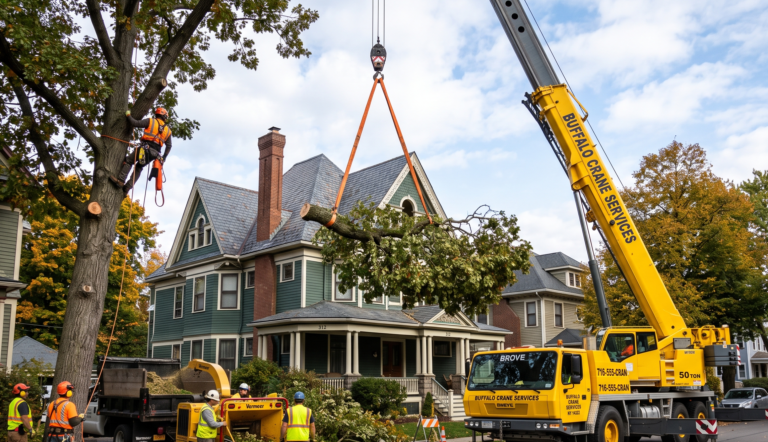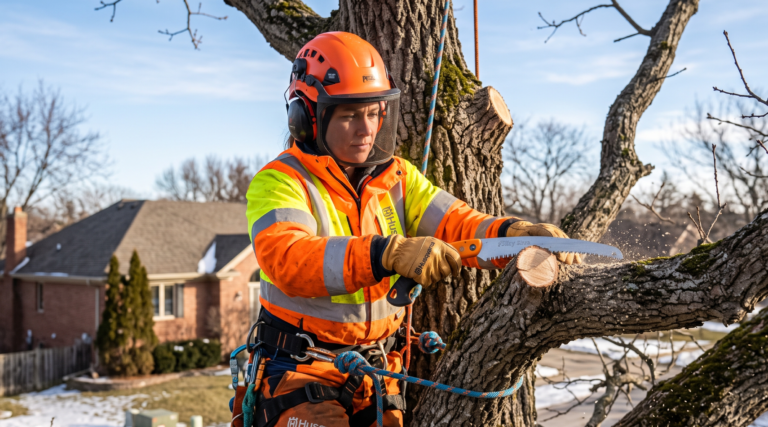

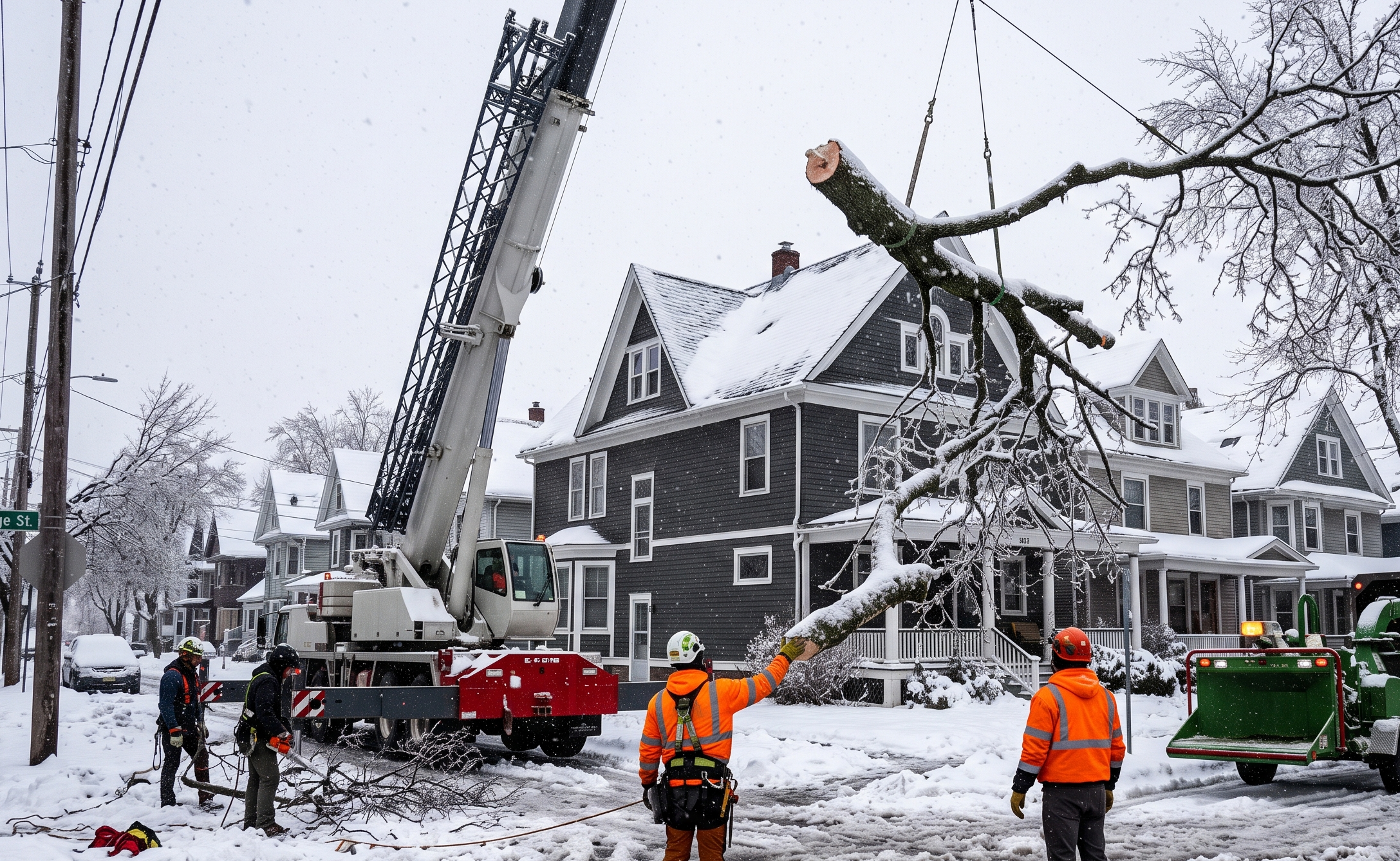
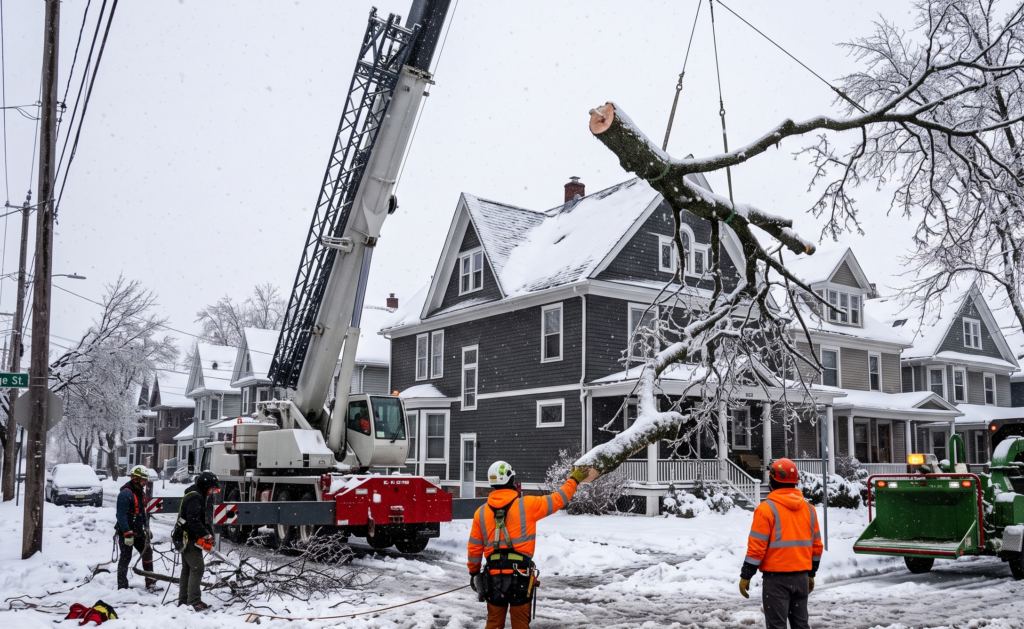
When winter weather bears down on Western New York, heavy lake-effect snow and ice threaten mature hardwoods in WNY with mechanical loading stresses seen in few other regions of the country. Across the dense lots of North Buffalo and Elmwood Village through suburban canopies in Amherst, Orchard Park, and Hamburg, century-old sugar maples, northern red oaks, green ashes, and historic American elms face substantial risk. The sudden arrival of moisture-saturated squalls off Lake Erie, combined with prolonged freezing rain glaze, creates immense vertical and torsional forces on structural branch unions. Without proactive canopy assessments, ANSI A300 structural pruning, or dynamic cabling, these storm cycles cause extensive property damage to rooflines, detached garages, and municipal utility lines.
Frequently Asked Questions
Q: Why are mature hardwoods in Western New York more vulnerable to winter failure than trees in other northern states?
A: Western New York sits directly downwind of Lake Erie. Early-to-mid-winter storms pass over unfrozen water, creating dense, moisture-laden snow at temperatures hovering between 30°F and 34°F. This heavy, sticky snow clings to branch bark far more aggressively than the dry, powdery snow typical in interior northern states.
Q: How does JensenStar Tree Company evaluate tree safety before storm season?
A: Our team performs comprehensive Level 2 visual risk assessments. We inspect main branch unions for included bark, measure load-bearing ratios, check for fungal conks indicating internal heartwood decay, and calculate whether the canopy’s center of gravity is dangerously offset.
The Anatomy of a Lake-Effect Storm: Why WNY Trees Face Unique Peril
Western New York’s geography produces a winter microclimate unlike anywhere else in the northern United States. As cold Arctic air masses track across the warm, open waters of Lake Erie, they absorb substantial thermal energy and moisture. As this unstable air moves inland and rises over elevated terrain—such as the Boston Hills and the Allegheny Plateau—it cools rapidly, condensing into narrow, stationary bands that drop massive amounts of precipitation over localized corridors.
The Weight of Wet Snow vs. Dry Powder
In cold continental storms, snow forms well below freezing, yielding light powder with a snow-to-liquid ratio of 15:1 or 20:1. Lake-effect events, conversely, often precipitate right at the freezing threshold (30°F to 34°F), creating dense, slush-laden snow with ratios as low as 6:1 or 8:1.
Frequently Asked Questions
Q: What makes lake-effect snow so much heavier than normal snowstorms?
A: Lake-effect snow forms from water vapor extracted directly from Lake Erie. Because it precipitates near 32°F, the snow crystals are moist and adhere immediately to branch surfaces, bonding into a consolidated, dense mass rather than blowing free in the wind.
Q: At what ice thickness do hardwood branches begin to fail?
A: Significant structural damage generally begins when radial glaze ice reaches 0.25 to 0.5 inches. Once ice thickness exceeds 0.75 inches, even healthy, mature primary scaffold branches will snap under the static weight, particularly when combined with wind gusts over 25 mph.
Biomechanical Breakdown: How Cold and Ice Overload Hardwood Limbs
Deciduous hardwoods are biologically structured to withstand dynamic lateral loads (wind). Their vascular systems, branch taper, and crown architecture allow them to shed horizontal force through flexure. However, immense vertical loads from glaze ice and dense snow compress these natural defense mechanisms beyond their physiological limits.
1. Elastic Limit and Modulus of Rupture
Hardwood fibers flex under temporary stress and return to their original position once the load clears. However, every tree species has a measurable Modulus of Rupture (MOR), which defines its structural breaking point. When glaze ice coats lateral limbs, the downward force creates high tensile stress along the upper branch surface and severe compression along the lower surface. If the load surpasses the branch’s MOR, the cellular matrix splinters, leading to immediate fracture.
2. Freeze-Induced Tissue Embrittlement
Sub-freezing temperatures freeze water contained within the sapwood, xylem, and living cambium layers. Ice crystal formation inside wood cells removes their natural pliability. Branches that would easily bend 30 degrees during summer thunderstorms turn brittle, fracturing cleanly under relatively modest loads when temperatures drop below 15°F.
3. Asymmetrical Crown Weight and Torsional Force
Lake-effect storms rarely drop snow evenly. Directional winds driving across Lake Erie load the windward side of a tree canopy with dense snow and rime, while the leeward side remains relatively bare. This unbalanced accumulation creates severe rotational (torsional) forces at the branch collars and root flare, twisting the trunk and pulling the tree’s natural center of gravity off its structural base.
Frequently Asked Questions
Q: Why do trees make loud cracking noises during extreme winter freezes?
A: Rapid drops in temperature cause the outer sapwood to contract faster than the inner heartwood, generating severe internal pressure known as “frost cracking.” Additionally, wood fibers under extreme tension from ice loads will audibly pop as individual cellular bundles begin to fail.
Q: What is the difference between compression and tension failure in a limb?
A: When a limb bends downward under snow, the top side experiences tension (fibers being pulled apart), while the bottom side experiences compression (fibers being crushed together). Hardwood usually fails first on the tension side, causing the top of the limb to snap and tear downward along the trunk.
Hardwood Species Vulnerability Index in Western New York
Tree physiology dictates cold-weather resilience. Wood density, branch junction angles, and internal growth patterns determine how well specific species hold up to heavy lake-effect accumulation.
| Tree Species | Wood Density / Hardness | Canopy Architecture | Vulnerability Rating | Primary Failure Modes |
| Silver Maple (Acer saccharinum) | Low (Brittle, porous) | Widespread, fast growth, narrow V-crotches | Severe Risk | Massive limb tear-outs; vertical trunk splitting at weak crotches containing included bark. |
| Boxelder (Acer negundo) | Low | Sprawling, multi-stemmed, weak vascular walls | Severe Risk | Stem collapse; trunk snapping under moderate ice loads. |
| Green & White Ash (Fraxinus spp.) | Compromised by EAB | Open, upright, brittle once infested | Critical Danger | Ash trees damaged by the Emerald Ash Borer lack core structural integrity; branches break unpredictably with no warning. |
| Norway Maple (Acer platanoides) | Moderate | Dense, compact, tight branch attachment angles | High Risk | Large surface area traps snow; frequent limb tear-outs at included bark seams. |
| Sugar Maple (Acer saccharum) | High | Well-balanced, strong natural fibers | Moderate | Vulnerable if neglected; large deadwood or hollow scaffold branches fail under heavy glaze. |
| Northern Red Oak (Quercus rubra) | Very High | Strong lateral scaffolds, high flexural strength | Low to Moderate | Extremely resilient; minor peripheral branch loss during severe ice storms, but main scaffolding holds. |
| American Beech (Fagus grandifolia) | High | Wide horizontal scaffolding, dense wood | Low | Resilient against bending; failures are typically isolated to limbs affected by beech bark disease. |
Frequently Asked Questions
Q: Why are Silver Maples so common in Western New York despite their storm vulnerability?
A: Silver maples were widely planted throughout Buffalo, Cheektowaga, and Tonawanda post-WWII because they grew quickly to provide immediate shade. Unfortunately, fast growth results in brittle, low-density wood that makes them the most frequently damaged trees during winter squalls.
Q: What should I do if I have an untreated ash tree near my home?
A: Untreated ash trees in Erie County have almost certainly been compromised by the Emerald Ash Borer. Because dead ash wood dries out and becomes extraordinarily brittle, these trees should be evaluated by an ISA-certified arborist immediately for prompt removal before winter storms bring them down.
Identifying Hidden Structural Defects Before the First Storm
A tree does not have to be diseased or dead to collapse during a storm. More often, structurally unsound mature hardwoods that look healthy in the summer split open under their first major winter load.
Co-Dominant Stems and Included Bark
When two stems of similar diameter grow upward from a single point, they often form a narrow, acute “V” union instead of a wide “”U”-shaped branch collar. As both stems grow, bark gets squeezed between them, creating included bark.
There is no structural wood connecting the two stems inside the union; they simply push against each other. When wet snow fills the canopy, it acts as a wedge, levering the stems apart and splitting the trunk down the center—often dropping a multi-ton section directly onto a roof or driveway.
Internal Heartwood Decay and Basal Cavities
Fungal pathogens enter trees through old flush cuts, lawn equipment wounds, or vehicle impacts. Wood-decay fungi slowly consume the structural lignin and cellulose in the tree’s interior heartwood, leaving an empty or rotted shell. While the outer sapwood can keep the canopy green all summer, a hollow trunk cannot bear the combined vertical weight of dense snow and strong winds.
Heavy End-Weight on Extended Limbs
Branches that grow long, horizontal, and un-tapered develop excessive leverage at their attachment point. Snow collecting on outer twigs magnifies this lever effect, often causing the branch to tear away cleanly at the trunk collar.
Frequently Asked Questions
Q: How do I tell if a tree fork has included bark?
A: Examine the junction where two main trunks meet. If you see a tight “V” shape with a deep vertical seam or roll of bark turned inward, the tree has included bark. A structurally sound union forms a wide, open “U” shape with a prominent ridge of raised bark on the outside of the joint.
Q: Can an arborist detect internal decay if there are no visible cavities?
A: Yes. Certified arborists use acoustic tomography or resistance micro-drilling (such as a resistograph). These diagnostic tools measure sound wave velocity or drilling resistance through the trunk to map internal hollows and decay zones without harming the tree.
Real-World Property Risks Across Buffalo & Erie County
Western New York’s residential architecture creates specific operational challenges when mature trees fail in winter.
The Urban Density Challenge (Elmwood Village, North Buffalo, Allentown)
In Buffalo’s historic streetscapes, century-old hardwoods sit on narrow tree lawns or in small backyards bordered by shared driveways and two-to-three-story homes.
- Restricted Drop Zones: Heavy branches often extend directly over slate roofs, dormers, and utility lines.
- Shared Utility Corridors: Service drops and primary electrical lines frequently run through private tree canopies in rear alleys and lot lines.
- Crane-Assisted Operations: Traditional felling techniques are impossible in tight spaces. Safely dismantling storm-damaged timber in these neighborhoods requires specialized mobile cranes to lift heavy limbs vertically up and over rooftops to the street.
The Southtowns Snowbelt (Hamburg, Orchard Park, East Aurora)
Communities situated in the path of Lake Erie’s primary lake-effect corridor regularly experience twice the snow accumulation of northern suburbs. In these areas, prolonged snowpack and mid-winter freeze-thaw cycles keep root zones saturated for weeks, weakening the soil’s shear strength and increasing the likelihood of whole-tree uprooting during high-wind squalls.
Frequently Asked Questions
Q: How do crane-assisted tree removals protect my property?
A: Instead of dropping heavy wood onto the lawn—which can damage turf, crush landscaping, or crack underground pipes—a crane secures the branch before it is cut. The operator then lifts the piece up and over your home, landing it directly in a street-side processing area for chipping.
Q: Why do trees uproot more easily during mid-winter thaws in the Southtowns?
A: Rapid snowmelt saturates clay-heavy soils, turning the ground soft and muddy. Without firm soil friction to anchor the root plate, strong winds off Lake Erie can lever the entire root system right out of the ground.
Proactive Arboricultural Care: Protecting Mature Hardwoods
Waiting for snow to start falling before addressing tree hazards leads to costly emergency calls. Preventative canopy care during late summer, autumn, or the dormant winter season keeps mature hardwoods structurally sound.
1. ANSI A300 Structural Pruning
Pruning is the most effective way to reduce storm damage:
- Crown Reduction & End-Weight Relief: Shortening long, heavy lateral limbs to reduce the lever arm that snow and ice press down on.
- Deadwood Removal: Removing brittle, dying, or dead branches 2 inches in diameter or larger before freezing temperatures make them brittle.
- Crown Thinning: Selectively pruning secondary branches to improve airflow and reduce surface area where wet snow can collect.
- Critical Precaution: Avoid “lion-tailing” (stripping out interior branches and leaving foliage only at the tips). This shifts weight outward, increasing end-load leverage and making branches far more likely to snap in winter storms.
2. Supplemental Support Systems: Cabling and Bracing
For trees with co-dominant stems or split-prone scaffold limbs, supplemental support systems provide mechanical reinforcement:
- Dynamic Cabling: Installing flexible synthetic lines in the upper two-thirds of the canopy. These cables allow natural movement in light winds, which encourages trunk strength, while catching and supporting limbs during heavy snow or ice loading.
- Static Steel Cabling & Through-Rods: For severe structural splits or heavy included-bark unions, threaded steel rods are installed through the junction, paired with rigid steel cables higher in the crown to physically hold the stems together.
3. Root Zone Care and Deep Root Injections
Healthy structural roots are essential to prevent winter uprooting. Soil compaction from foot traffic or vehicles weakens fine-absorbing roots. Liquid soil injections containing mycorrhizal fungi, organic matter, and slow-release nutrients improve root density and anchor trees securely in place.
Frequently Asked Questions
Q: Does pruning a tree in the late fall or winter hurt it?
A: No, dormant pruning is actually ideal. Without leaves, an arborist can clearly evaluate the tree’s branching structure, locate hidden cracks, and make clean, precise cuts. The tree seals these wounds quickly once spring growth begins.
Q: Can you cable a tree that is already leaning?
A: Cabling is designed to support weak branch unions, not to hold up a tree whose root plate is actively lifting. Leaning trees with compromised root systems require an immediate hazard assessment to determine if safe stabilization or complete removal is the appropriate step.
What Homeowners Should Never Do During an Ice or Snow Event
During a heavy lake-effect storm, well-meaning attempts to help weighed-down trees often cause severe property damage or serious physical injury.
Frequently Asked Questions
Q: What should I do if a heavy branch is bending so low it touches my car or roof?
A: Do not try to lift or shake the branch yourself. The wood is under severe tension and can snap without warning or drop hundreds of pounds of compacted snow and ice onto you. Keep clear and call a professional tree service with proper rigging equipment.
Q: Is it safe to run a generator underneath a bent tree canopy?
A: No. Falling ice or snapping branches can crush the generator, sever fuel lines, and create fire hazards, while exhaust fumes can become trapped around nearby house windows. Always operate generators in clear, open areas well away from tree drip lines.
What to Do When a Tree Suffers Winter Storm Damage
If winter weather damages a tree on your property, take these four steps to protect your family and home:
- Establish a Safe Perimeter: Keep everyone well away from damaged canopies. Cracked limbs caught overhead (often called “hangers” or “widow-makers”) can drop unexpectedly hours or days after a storm passes.
- Check for Utility Line Hazards: If a fallen tree or broken branch is touching power, telephone, or cable lines, stay back at least 30 feet and contact your utility provider (National Grid or NYSEG) right away. Never touch a tree limb that is in contact with utility lines.
- Photograph the Damage for Insurance: Document damaged roofs, siding, fences, or vehicles with clear, wide-angle photos from a safe distance before anything is moved or cleared.
- Call a Fully Insured Professional: Contact an ISA-certified tree company that carries both comprehensive general liability and workers’ compensation insurance and has the equipment needed to handle hazardous, tension-loaded timber safely.
Frequently Asked Questions
Q: Does homeowners insurance pay for tree removal after a storm in New York?
A: If a tree falls and damages an insured structure—such as your house, garage, or shed—homeowners insurance typically covers the cost of tree removal from the structure, as well as repairs (minus your deductible). However, if a tree falls on an open lawn without damaging property, removal costs are generally not covered.
Q: Who pays if my neighbor’s tree falls onto my house during a winter storm?
A: Under New York State law, storm damage caused by a neighbor’s tree is considered an “Act of God,” meaning your own homeowners insurance policy pays for the repairs to your property. The neighbor is usually only liable if the tree was documented as dead, diseased, or hazardous prior to the storm, and they failed to address it.
Local Municipal Tree Regulations in Western New York
Pruning or removing large mature hardwoods across Erie County requires attention to local municipal tree preservation ordinances:
- City of Buffalo & Town of Amherst: Trees growing in the public right-of-way (the tree lawn between the sidewalk and street) belong to the municipality. Homeowners are not permitted to prune or remove them without written authorization from the municipal forestry department.
- Village of Hamburg, Kenmore, & East Aurora: Specific local codes regulate the removal of mature trees based on trunk diameter (Diameter at Breast Height, or DBH), even on private property. Removing significant trees without an arborist’s risk assessment can result in municipal stop-work orders and fines.
- At JensenStar Tree Company, we manage municipal permits, environmental documentation, and utility clearance notifications on our clients’ behalf to ensure every project complies with local regulations.
Frequently Asked Questions
Q: How do I know if a tree is on my property or belongs to the town?
A: Review your property boundary survey. Trees whose trunks fall within the public road right-of-way or the sidewalk easement belong to your local municipality. When in doubt, our team can help confirm property lines during an on-site evaluation.
Q: Can the city fine me for trimming a municipal street tree that hangs over my private driveway?
A: Yes. Many Western New York municipalities enforce strict fines for unauthorized pruning of street trees. If a municipal tree poses a hazard to your property, submit a work request to your local Department of Public Works or Forestry Bureau.
Rapid Storm Response & Tree Care Services Near You in Western New York
When a lake-effect band or ice storm compromises a large hardwood, waiting days for help increases the chance of structural failure. Homeowners and property managers searching for an emergency tree service near you need fast access to crews equipped for tough winter conditions.
From our central facility on Montana Avenue in Buffalo, JensenStar Tree Company provides rapid-dispatch emergency tree removal, hazard mitigation, and storm-damage pruning across Erie and Niagara counties:
- Buffalo Metro & Historic Districts: Elmwood Village, Allentown, North Buffalo, South Buffalo, Delaware District, and Parkside.
- Northern Suburbs: Amherst, Williamsville, Tonawanda, Kenmore, Clarence, Cheektowaga, and Grand Island.
- Southtowns Snowbelt: Orchard Park, Hamburg, West Seneca, East Aurora, Boston Hills, Lancaster.
Local Dispatch & Operational Headquarters
Use the interactive map below to confirm our response range to your property, verify our physical location, or get driving directions to our Buffalo yard:
Frequently Asked Questions
Q: How quickly can an emergency crew reach my property during a winter storm?
A: For active emergencies—such as limbs resting on roofs, trees blocking driveways, or leaning trunks threatening structures—our Buffalo-based crews prioritize urgent calls and can typically mobilize across Erie County within 2 to 4 hours, subject to travel bans and road conditions.
Q: Do you offer free on-site tree hazard evaluations?
A: Yes, we provide property owners throughout our service area with free visual tree inspections and detailed, written estimates for structural pruning, cabling, or crane-assisted removals.
Protecting Buffalo’s Urban Canopy for Generations to Come
Western New York’s mature hardwood trees are central to our communities. They shade historic neighborhoods, raise property values, and contribute to the region’s landscape. While Lake Erie will always generate intense winter weather, catastrophic tree failure does not have to be an inevitable part of the season.
With regular preventative care, expert crown thinning, modern cabling systems, and responsive local storm services, you can protect your trees through the toughest winter storms.
Frequently Asked Questions
Q: How often should mature trees receive an inspection from an arborist?
A: We recommend having mature hardwoods inspected every 2 to 3 years. Trees older than 50 years or those planted close to homes, driveways, or utility lines should receive a quick annual check before storm season.
Q: Can a mature tree recover if it loses a large secondary limb during a storm?
A: Yes, as long as the trunk and root plate remain intact. A certified arborist can make clean, proper cuts to remove ragged bark and broken wood, allowing the tree to naturally compartmentalize the wound and prevent internal decay.
Schedule Your Pre-Winter Tree Inspection with JensenStar Tree Company
Don’t wait for a heavy lake-effect storm to uncover hidden structural flaws in your trees. Protect your home, family, and landscape today.
- Phone: (716) 703-5666
- Office: 79 Montana Ave, Buffalo, NY 14211
- Service Area: Buffalo, Amherst, Cheektowaga, Tonawanda, West Seneca, Hamburg, Orchard Park, and surrounding Erie County communities.
- Credentials: ISA-Certified Arborists | Fully Insured (General Liability & NYS Workers’ Comp) | Crane-Assisted Removals for Tight Urban Lots