
When a mature, eighty-foot silver maple or decaying red oak leans over a historic slate roof along Elmwood Avenue, Richmond Avenue, or the tree-lined parkways of North Buffalo, traditional tree felling is completely off the table. In these historic Western New York neighborhoods, property boundaries are narrow, lot lines are razor-thin, and Queen Anne, Craftsman, and Victorian eaves often sit barely six to ten feet apart. For property owners facing hazardous canopy decline, tight-quarter tree removal requires surgical precision. By deploying an engineered 50-ton hydraulic crane, JensenStar Tree Company eliminates the destructive ground drop zone, hoisting multi-ton timber directly up and out over fragile roofs, gutters, and utility service drops without risking property impact below.
Carrying out heavy tree work in dense Buffalo neighborhoods requires an uncompromising balance of mechanical engineering, aerial rigging expertise, and deep familiarity with local urban forestry. Whether navigating primary electrical lines near Delaware Park, preserving century-old landscaping off Hertel Avenue, or dismantling a rotting trunk inside an inaccessible backyard, crane-assisted arboriculture represents the gold standard of modern structural defense.
The Reality of Tight-Quarter Lots in Elmwood Village & North Buffalo
Elmwood Village and North Buffalo contain some of the most architecturally striking and dense residential corridors in upstate New York. Built largely between the late 19th and early 20th centuries, these neighborhoods were laid out long before the advent of modern utility infrastructure, heavy vehicles, or the maturity of the canopy that shades them today.
Homeowners across Elmwood Village, the Delaware District, Parkside, and North Buffalo regularly encounter specific property constraints that complicate arboricultural work:
- Zero Lot-Line Proximity: Shared driveways, narrow breezeways, and properties where neighboring eaves overlap mean there is zero margin for uncontrolled branch swings.
- Historic & Fragile Architecture: Intricate copper flashing, steep slate roof tiles, ornate turrets, wraparound cedar porches, and historic stained glass windows are vulnerable to even minor debris ricochet.
- Backyard Islanding: Massive heritage trees frequently stand enclosed behind continuous fences, detached carriage houses, detached garages, and brick patios, entirely cut off from conventional ground machinery, skid steers, or bucket trucks.
- Webs of Overhead Utilities: Secondary power drops, telephone connections, high-speed fiber-optic lines, and municipal service lines crisscross side yards, creating potential snags for falling limbs.
- Subsurface Infrastructure: Century-old stone sewer laterals, gas supply lines, and fragile flagstone walkways make driving heavy wheeled machinery across lawns unacceptable due to severe soil compaction and pipe crushing risks.
When a massive tree on one of these properties reaches the end of its life cycle—whether hollowed by internal rot, stressed by severe Western New York winter storms, or undermined by root girdling—letting it come down piece by piece with standard rope drops poses unacceptable risks.
Frequently Asked Questions
Q: How close can a tree be to an Elmwood Village home before it requires crane extraction?
A: When a tree’s main stem or primary load-bearing canopies sit within 10 to 15 feet of an eave, dormer, or shared property boundary, traditional directional falling is impossible. In zero lot-line settings where neighboring houses are separated by only 6 to 10 feet, crane removal is typically required to lift timber vertically rather than risk horizontal drift.
Q: Will tree removal equipment crack century-old Buffalo driveways or flagstone paths?
A: Moving standard heavy equipment (like skid steers or mini-loaders) repeatedly over historic driveways can crack aged asphalt, fracture decorative pavers, and damage subterranean clay sewer laterals. Utilizing a street-staged 50-ton crane bypasses driveway and lawn surfaces entirely by hoisting timber overhead.
Q: Who is responsible if a tree spans across a property line between two North Buffalo houses?
A: Under New York state common law, a tree whose trunk crosses a boundary line is considered a “boundary tree” and joint property of both homeowners. Both parties must consent to complete removal. If branches merely overhang your roof from a neighbor’s tree, you generally have the legal right to trim up to the property line, provided the pruning does not compromise the structural health or stability of the tree.
Why Traditional “Piecing Out” Fails in Dense Urban Quarters
Homeowners often ask, “Can’t an arborist simply climb the tree and cut it down branch by branch?”
In open suburban areas, manual sectional dismantling—known as “piecing out” a tree—is standard practice. A climber ascends the canopy, ties off a limb using friction hitches and lowering blocks, saws the branch off, and ground personnel lower it into a designated yard drop zone. However, in tight quarters like Elmwood Village, that traditional method carries significant structural risks:
1. Shock Loading on Questionable Wood
When a climber cuts a multi-thousand-pound branch tied off to the main trunk, gravity pulls the piece downward until the rope catches it. This sudden deceleration causes shock loading—a violent dynamic force transferred down through the stem of the tree. If the tree is being removed due to internal decay, heart rot, fungus, or Emerald Ash Borer infestation, the host trunk can snap under this sudden jolt, endangering the climber, the home, and adjacent structures.
2. Pendulum Effect and Drift
Lowering ropes do not drop wood vertically; they swing it in an arc. In spaces where homes sit 8 to 12 feet apart, even a slight arc can launch a swinging heavy log directly into a brick chimney, a slate dormer, or a neighbor’s vinyl siding.
3. Lawn Compaction and Structural Pavement Failure
Manually hauling hundreds of logs through a narrow backyard gate requires countless trips using motorized mini-skid steers or hand dollies. This continuous ground traffic destroys established sod, crushes underground sprinkler systems, cracks decorative paver patios, and can collapse aged brick sewer drains beneath older Buffalo driveways.
Frequently Asked Questions
Q: What is “shock loading,” and why is it dangerous during tree removal?
A: Shock loading occurs when a cut branch drops on a rigging line and abruptly snaps taut against the host tree trunk. The sudden dynamic force can exceed several times the static weight of the limb. If the tree trunk suffers from internal hollows, fungal decay, or insect rot, this shock can snap the trunk, endangering the climber and neighboring buildings.
Q: Can rope rigging be used if a backyard is fully enclosed by fences?
A: While rope lowering can technically drop pieces into a small yard, ground personnel must still manually haul thousands of pounds of heavy wood through narrow pedestrian gates. This creates extensive lawn rutting, destroys garden beds, and significantly increases labor hours and overall project costs.
Q: Why can’t a bucket truck just drive into my backyard off Hertel or Potomac Avenue?
A: Most residential backyards in North Buffalo and Elmwood Village lack vehicle access due to tight side yards, fences, and detached garages. Additionally, a standard bucket truck weighs between 25,000 and 40,000 pounds; driving that weight over residential lawns risks severe soil compaction, damaged root zones of remaining trees, and underground utility damage.
The Mechanical Solution: How a 50-Ton Crane Transforms Tree Removal
Deploying a mobile 50-ton hydraulic boom crane turns tree removal from an uncontrolled demolition problem into an engineered lifting operation.
Instead of cutting branches and letting gravity pull them downward, the crane neutralizes gravity before the cut is ever made.
Vertical Extraction Mechanics
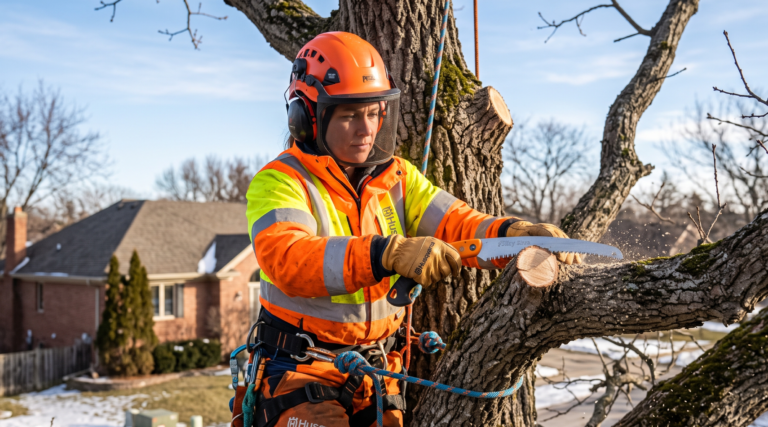
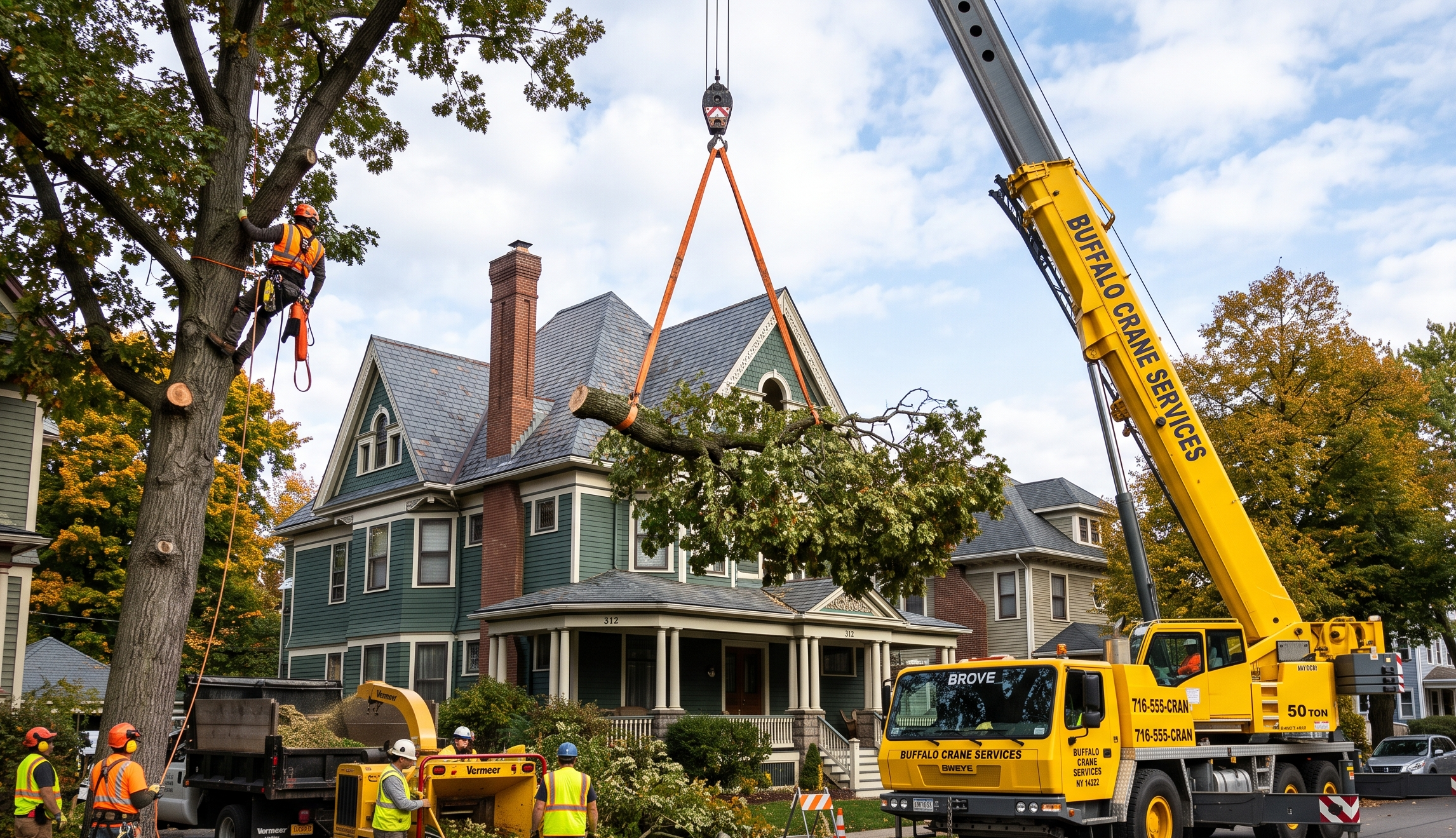
- The Hookup: An experienced climber or aerial-lift arborist ascends into the tree and secures the crane’s load line directly to the center of gravity of the target branch or trunk section using certified synthetic slings and steel shackles.
- Pre-Tensioning: The certified crane operator engages the hydraulics, taking up the slack until the cable holds the exact static weight of that timber section.
- The Clean Cut: The tree worker makes a precise release cut (typically an undercut followed by a clean top cut). Because the crane is holding the full load, there is no violent kickback, no uncontrolled dropping, and zero shock loading on the remainder of the trunk.
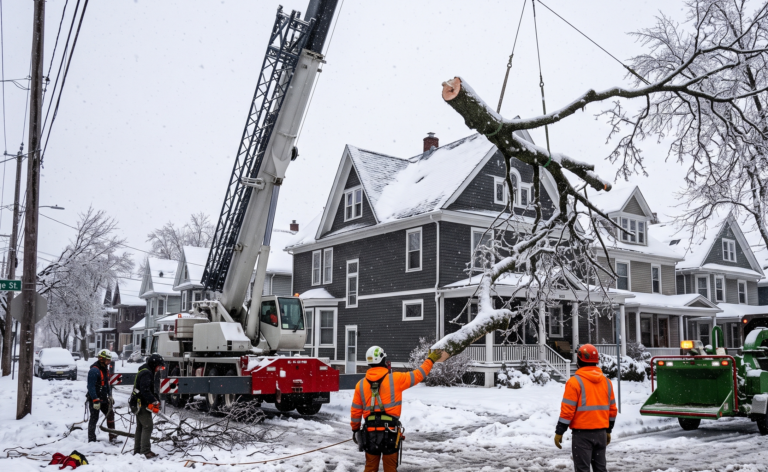
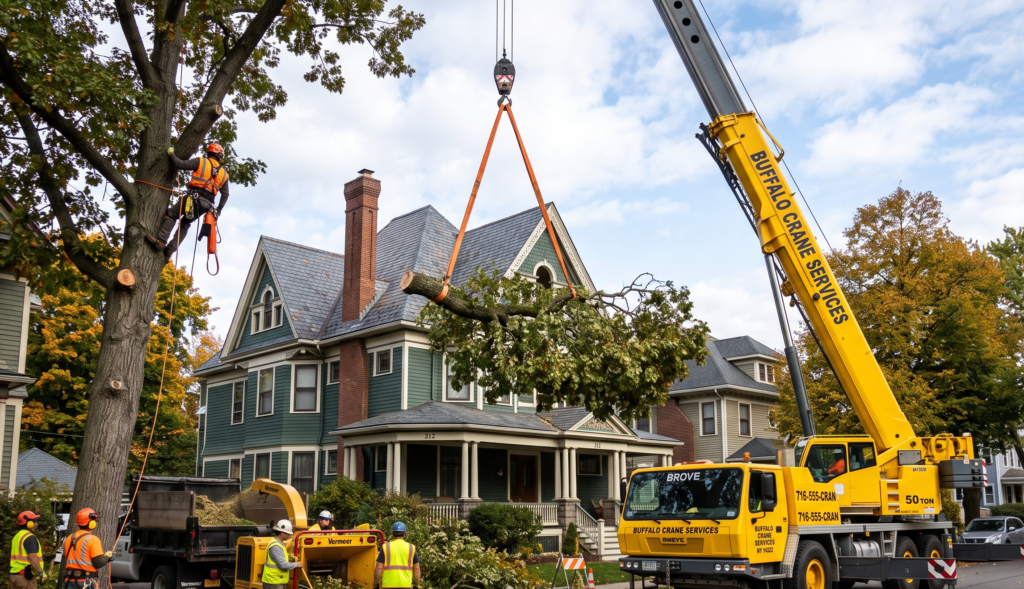
- The Sky Lift: The operator gently hoists the detached multi-ton canopy section vertically into the open sky, completely clearing the roofline, utility drops, and surrounding fences.
- The Drop & Process Zone: The crane swings the timber safely over the home to the street or driveway, laying it down flat directly in front of the wood chipper and log truck. Crew members process the wood curbside, completely bypassing the yard.
By taking the ground out of the equation, the danger to roofs, landscape beds, and perimeter property lines is eliminated.
Frequently Asked Questions
Q: How does a crane lift a tree without dropping debris onto the roof below?
A: Before the cutting arborist makes a single cut, the crane’s load line is securely attached to the branch’s center of balance and pre-tensioned. The operator takes up the full weight of the section so that when the cut is completed, the branch remains floating in place. The crane then lifts the timber straight upward, clearing the roofline before moving horizontally.
Q: Where does the wood go once lifted over the house?
A: The crane deposits the suspended wood directly into the street or driveway landing zone. Crew members immediately process limbs through a high-capacity industrial wood chipper and load main log sections straight into hauling trucks, keeping your lawn and yard completely untouched.
Q: How long does a crane-assisted tree removal usually take?
A: A complex, large-scale tree removal that would take a traditional climbing and rigging crew 2 to 4 days can typically be completed in 4 to 8 hours with a 50-ton hydraulic crane.
50-Ton Crane vs. Traditional Rigging in Historic Neighborhoods
| Operational Factor | Traditional Sectional Rigging | 50-Ton Crane-Assisted Removal |
| Roof & Gutter Impact Risk | Moderate to High (debris bounce, line sway) | Near Zero (picks move straight up and out) |
| Ground & Lawn Disturbance | Heavy (foot paths, equipment tracking, lawn damage) | Minimal (all processing done at the curbside) |
| Backyard Access Capability | Limited to narrow gates; manual labor intensive | Overcomes multi-story buildings and tall fences |
| Time Required on Site | 2 to 4 full days for complex mature trees | Typically completed in a single working day |
| Climber Safety Margin | Low on hollow, rotted, or structurally dead trunks | Maximum (arborists never rely on unstable stems) |
| Overhead Line Hazards | Constant entanglement and snag risks | Loads plucked straight above wires under radio control |
| Neighborhood Disruption | Multi-day noise, debris, and yard access blockage | Rapid, systematic staging with clear street clearance |
Frequently Asked Questions
Q: Is crane tree removal more expensive than manual tree removal?
A: While bringing a crane involves specialized heavy machinery, it often costs less or equals manual rigging on large trees because it condenses multiple days of labor into a single workday while avoiding thousands of dollars in potential roof, gutter, or lawn repairs.
Q: Can a crane remove trees located completely behind a three-story house?
A: Yes. A 50-ton hydraulic crane features an extended telescoping boom that reaches up to 110+ feet vertically and across horizontal spans, allowing it to lift trees out of fully landlocked courtyards and rear lots.
Protecting the Historic Rooflines of Western New York
Homes in North Buffalo and Elmwood Village feature architectural details rarely seen in newer builds. Protecting these properties during major canopy removals requires an understanding of how distinct building materials respond to tree-work environments:
Slate and Terracotta Tiles
Many landmark residences in the Delaware Park and Elmwood corridors retain original slate roofs. Slate is brittle. A dropped four-inch branch falling thirty feet can shatter several courses of slate, causing water intrusion that costs thousands of dollars to trace and repair with specialized artisan roofers. Crane picks up branches straight up and away, ensuring no fragments drop or bounce off steep-pitched roofs.
Box Gutters and Architectural Copper Details
Historic Victorians often feature built-in wooden box gutters lined with copper or tin. Traditional tree ropes wrapped around limbs run the risk of dragging heavy branches across these delicate eaves, bending custom metalwork, or puncturing seams. Crane operations keep all cut wood completely clear of exterior gutter profiles.
Steep Multi-Gable Pitches
Elmwood Village houses are famous for complex roof architectures—cross gables, dormers, and decorative turrets. Rigging through complex roof geometries using ground ropes is notoriously unpredictable. The high vertical boom of a 50-ton crane clears peak ridges effortlessly, giving operators unobstructed 360-degree lift arcs.
Frequently Asked Questions
Q: Can tree work damage historic slate or terracotta tile roofs?
A: Yes. Historic slate and terracotta are brittle and cannot withstand direct impact. Even small branches ricocheting off a slope can crack slate tiles, causing leaks that require custom, expensive artisan restoration. Crane picks prevent any debris from contacting the roof surface.
Q: What precautions protect custom copper box gutters during tree dismantling?
A: Lowering lines can swing wood into eaves, bending metal seams and pulling down gutters. Because crane operations lift timber completely vertical and clear of the roofline, gutter profiles remain entirely out of the load path.
Q: Does homeowner insurance cover roof damage caused by tree removal companies?
A: Reputable arborists carry dedicated commercial general liability and worker’s compensation insurance specifically covering high-risk crane and tree operations. Always verify that your tree contractor has active, arborist-specific liability coverage before work begins.
The Engineering Behind Tight-Quarter Crane Setup
Placing a 50-ton crane on a narrow residential street like Linwood Avenue, Colvin Avenue, or Potomac Avenue is an exercise in exact civil planning and mechanical safety. It is not simply a matter of parking the truck and extending the outriggers; it involves calculated weight distribution and situational setup:
Outrigger Load Displacement
A 50-ton crane uses hydraulic outriggers that extend from the chassis to stabilize the rig during hoisting. To protect Buffalo’s asphalt, municipal curbs, and subsurface utilities, our team places engineered outrigger pads and heavy composite timber mats underneath every steel foot. This spreads the mechanical weight across an expanded surface area, preventing sidewalk cracking, driveway rutting, or ground settling.
Calculating Radius, Boom Length, and Load Charts
Cranes do not lift 50 tons at maximum reach; lifting capacity decreases as the boom extends horizontally. Before any pick is made:
- The team calculates the exact distance from the crane base to the tree’s center.
- The arborist estimates the green weight of the wood piece (accounting for wood density, moisture content, and species weight—such as waterlogged oak or green maple).
- The crane operator verifies the load chart, ensuring the total pick weight remains comfortably within the crane’s rated safety margin (keeping cuts well under 70% of maximum chart limits).
Constant Radio Communication
Blind picks—where the crane operator cannot visually see the backyard where the tree is being cut—are common in North Buffalo. To maintain total command, JensenStar uses closed-circuit, direct two-way headsets (hands-free wireless communication) between the cutting arborist in the canopy, the crane operator in the cab, and the crew leader on the ground. Every millimeter of movement is verbalized in real time.
Frequently Asked Questions
Q: Will the weight of a 50-ton crane crack my street curb or driveway apron?
A: Professional tree removal teams utilize heavy-duty composite outrigger pads and timber mats under each hydraulic outrigger leg. This distributes the downward pressure across a large surface footprint, preventing asphalt rutting, concrete cracking, or damage to underground utilities.
Q: What is a “blind pick” during crane-assisted tree removal?
A: A blind pick occurs when the crane operator’s direct line of sight to the backyard tree is blocked by the home. To maintain safety, the operator, the aerial cutting arborist, and the ground crew communicate continuously using hands-free wireless headsets and standard arborist hand and verbal signals.
Q: Do I need a city permit to park a crane on an Elmwood Village street?
A: Yes. Staging large equipment in municipal rights-of-way requires street occupancy and parking clearance permits from the City of Buffalo. JensenStar coordinates street logistics and lane permits as part of project staging.
Step-by-Step: The Anatomy of a Crane Removal Project
When property owners contact JensenStar Tree Company for tight-quarter tree removals in Western New York, we follow an exact, disciplined process designed to eliminate surprises.
1. Site Evaluation & Obstacle Survey
We assess property lines, structural eaves, overhead utilities, and crane staging areas.
2. Permitting & Local Street Logistics
Securing municipal street space, parking clearances, and staging coordinates.
3. Outrigger Matting & Rigging Anchors
Displacing chassis load, deploying high-capacity rigging, and testing lift arcs.
4. Canopy Balancing & Sectional Picks
Arborists make strategic cuts; crane hoists timber vertically over structural peaks.
5. Curbside Chipping, Hauling & Cleanup
Wood is processed directly into trucks; yards and walkways are raked and swept clean.
Phase 1: Site Evaluation and Hazard Survey
Our certified team visits your property to examine the tree species, trunk integrity, structural defects, lean angle, and proximity to buildings. We inspect ground elevations, access alleys, and overhead electrical lines, mapping the optimal placement point for the mobile crane.
Phase 2: Logistics and Street Permits
In dense Buffalo neighborhoods, setting up heavy equipment requires street management. We coordinate local municipal parking permits or lane closures when necessary, ensuring safe perimeter corridors for neighbors, pedestrians, and passing vehicles.
Phase 3: Crane Positioning and Matting
On the morning of the operation, the 50-ton crane is positioned in the driveway or street. High-density composite load-distribution pads are deployed under each outrigger foot. Safety perimeters are cordoned off with high-visibility cones and tape.
Phase 4: Systematic Aerial Dismantling
Working from top to bottom, our arborist cuts the canopy into manageable sections. The crane hoists each limb upward, guides it across the roof without touching a single shingle, and lowers it directly down into the designated landing zone on the street. The main trunk is then taken down in uniform vertical cuts until only the low stump remains.
Phase 5: Processing, Stump Grinding, and Total Cleanup
Curbside crews immediately feed brush through our high-capacity wood chippers, while heavy trunk logs are loaded onto haulers. If selected, our specialized stump grinding equipment moves in to grind the subterranean root flare beneath lawn grade. Finally, every lawn, porch, driveway, and gutter is leaf-blown and raked clean.
Frequently Asked Questions
Q: Do I need to be home while the tree is being removed with the crane?
A: It is recommended to be present at the start of the morning to confirm property markers, vehicles, and access gates with the crew leader. However, as long as vehicles are moved out of the staging area, pets are secured indoors, and access is clear, you do not need to remain on-site the entire day.
Q: What happens to the tree stump after the canopy is removed?
A: The crane lowers the main trunk in sections until a low stump remains (typically 4 to 12 inches above grade). A specialized stump grinder is then brought in to grind the stump and root flare 6 to 12 inches below ground level, leaving the area ready for topsoil, sod, or landscape replanting.
Q: How noisy is a crane-assisted tree removal?
A: While hydraulic cranes themselves are relatively quiet, chainsaws and high-capacity wood chippers generate significant noise during curbside processing. Because crane jobs move substantially faster than manual jobs, total neighborhood noise duration is condensed into a single working day.
Species-Specific Tree Challenges in Elmwood & North Buffalo
The urban forest canopy across Elmwood Village and North Buffalo contains diverse mature tree species, each presenting unique structural issues as they enter senescence:
Silver Maples (Acer saccharinum)
One of the most common mature trees in Western New York, silver maples grow quickly but possess notoriously weak, brittle wood. Decades of heavy lake-effect snowstorms create internal stress cracks and pocket rot at multi-stem unions. When taking down a massive silver maple looming over a house, conventional rigging can break rotted unions prematurely. Cranes provide the delicate suspension needed to stabilize weak limbs as they are separated.
Ash Trees (Fraxinus americana / pennsylvanica)
The devastation wrought by the Emerald Ash Borer has left thousands of dead ash trees throughout the greater Buffalo region. Dead ash wood loses its moisture content quickly, becoming structurally brittle and prone to unpredictable “ash snap.” Climbers cannot safely ascend a severely dead ash, nor can the tree support the tension of conventional drop ropes. A 50-ton crane eliminates the need to rely on the trunk’s integrity, holding the weight from above and allowing the arborist to work safely from an aerial bucket or crane harness.
Red & White Oaks (Quercus rubra / Quercus alba)
Oaks are extremely dense, heavy hardwoods. A single fifteen-foot horizontal limb over an Elmwood porch can weigh between 3,000 and 6,000 pounds. In tight quarters, lowering that much concentrated mass without crane support is practically impossible. Cranes carry that weight with ease, mitigating all impact forces.
Frequently Asked Questions
Q: Why are silver maples prone to sudden failure during lake-effect storms?
A: Silver maples grow quickly and develop narrow, V-shaped crotches with included bark. Over time, internal rot develops at these unions, making them weak under heavy lake-effect snow and high winds from Lake Erie.
Q: Is it safe to climb an ash tree killed by Emerald Ash Borer (EAB)?
A: No. Ash wood dries out rapidly once killed by EAB, resulting in “ash snap”—a condition where limbs or whole trunks shatter under human weight without warning. Dead ash trees should always be dismantled using an aerial bucket or crane hook without climbers anchoring into dead wood.
Q: How much does a mature oak branch weigh?
A: Green oak wood weighs approximately 55 to 64 pounds per cubic foot. A single large lateral limb measuring 18 inches in diameter and 20 feet long can easily weigh between 2,500 and 3,500 pounds, requiring a crane to lift safely over roofs.
Western New York Climate Realities: Lake-Effect Storms & Canopy Stress
Buffalo’s geographical position between Lake Erie and Lake Ontario subjects its urban trees to weather extremes found in few other metropolitan areas. Wet, early-season autumn snowstorms (such as the historic October surprise storms) and late-winter freeze-thaw cycles coat mature canopies in thousands of pounds of heavy ice and wet snow.
Over decades, these repeated storm loads cause:
- Internal shear stresses along primary trunk splits.
- Undetected canopy stress fractures that rot over subsequent summers.
- Soil heave and root destabilization from freeze-thaw cycles combined with high spring water tables.
When an old tree has survived thirty years of lake-effect freezes, its interior wood fibers are often far more fatigued than they appear from the outside. Homeowners who wait until a storm exposes that damage often face emergency removals under dangerous weather conditions. Proactive tree removal with a 50-ton crane allows you to handle compromised, hazard-prone trees on a controlled schedule, safely protecting your roof before the next gale-force front rolls off Lake Erie.
Frequently Asked Questions
Q: When is the best time of year to remove a hazardous tree in Buffalo?
A: Late fall and winter are ideal. The ground is firmer (minimizing turf stress), leaves are down (reducing wind resistance and pick weight), and the hazard is eliminated before heavy lake-effect snow and ice storms hit.
Q: How does the freeze-thaw cycle affect Buffalo tree root systems?
A: Rapid temperature swings cause frost heave, which can loosen shallow root systems in clay-rich soils. Combined with high spring water tables, mature trees with compromised structural roots face an increased risk of complete windthrow during high-wind gale warnings.
The Homeowner Checklist: Preparing for Crane Tree Removal
If you are scheduling a crane-assisted tree removal on your property in North Buffalo or Elmwood Village, taking a few preparatory steps ensures a seamless operation:
- Clear Driveways and Curbside Parking: Ensure street space in front of your home is clear of personal vehicles so the crane and chip trucks can stage without delay on project day.
- Notify Immediate Neighbors: Let your neighbors know a crane will be operating on the street. If your property shares a driveway, ensure all vehicles that need to leave for work are parked outside the work zone before morning arrival.
- Secure Pets and Family Indoors: While crane removals are remarkably controlled, chainsaws and heavy machinery are active outside. Keep children and pets safe indoors throughout the job.
- Clear Backyard Patio Items: Move patio furniture, potted planters, bird baths, and barbecue grills away from the work zone beneath the canopy to give ground crew clear access.
- Mark Invisible Irrigation & Invisible Fences: Point out any underground sprinklers, buried low-voltage lighting wires, or landscape features to our crew leader during morning setup.
Frequently Asked Questions
Q: What should I do with my vehicles the morning of crane setup?
A: Move all vehicles you plan to use out of the garage and driveway onto a nearby side street the night before or early morning, ensuring the crane and chipper trucks have direct, unobstructed access to the staging area.
Q: Should outdoor patio furniture be moved before the tree crew arrives?
A: Yes. Clear patio chairs, tables, potted plants, grills, and children’s toys away from the work zone beneath the canopy to allow the aerial ground spotters and cutters unobstructed access.
Crane Tree Removal “Near Me”: Serving Elmwood Village, North Buffalo & Greater Erie County
When severe weather strikes or a dangerous tree threatens your home, searching for “crane tree removal near me“ or an “emergency tree service near me“ often returns general landscaping crews who lack heavy lifting equipment.
JensenStar Tree Company operates specialized 50-ton hydraulic cranes and tight-access tree equipment engineered specifically for high-density Western New York neighborhoods. Based at 79 Montana Ave in Buffalo (14211), our rapid-response rigging crews provide tight-quarter crane tree removal, hazardous limb dismantling, and complete stump grinding throughout the following local zones:
- Elmwood Village & Delaware District: Zero lot-line extractions along Elmwood Ave, Richmond Ave, Ashland Ave, Norwood Ave, and Bidwell Parkway.
- North Buffalo & Parkside: Precision picks near Hertel Ave, Colvin Ave, Starin Ave, Amherst St, and surrounding Olmsted Parkways.
- Surrounding Erie County Communities: Rapid dispatch to Kenmore, Tonawanda, Amherst, Williamsville, Allentown, and South Buffalo.
If your property is located within walking distance of Delaware Park, Buffalo State University, or anywhere across the City of Buffalo, our crane fleet reaches over structural obstacles, multi-story buildings, and tight fences without requiring heavy machinery on your lawn.
Find Our Local Buffalo Dispatch Hub
Frequently Asked Questions
Q: How quickly can a crane crew dispatch to Elmwood Village or North Buffalo for an emergency?
A: Because our central dispatch hub is located at 79 Montana Ave, our crews are within 10 to 15 minutes of Elmwood Village, Hertel Avenue, and the Delaware District, allowing for rapid same-day site hazard evaluations.
Q: Do you service residential areas outside the City of Buffalo?
A: Yes. We regularly provide tight-quarter crane tree removals across Amherst, Kenmore, Tonawanda, Cheektowaga, West Seneca, and Williamsville.
Why Buffalo Property Owners Choose JensenStar Tree Company
Safely executing crane-assisted removals requires a tree care company that pairs heavy equipment with arboricultural know-how. At JensenStar Tree Company, our crews are trained specifically in the complex logistics of tight-quarter Western New York tree work:
- Experienced Crane Operators & Riggers: Our team is trained in zero-impact aerial extraction techniques, precision balance points, and calculated green-weight management.
- Property-First Philosophy: We treat your grounds, slate roofs, and historic architectural trim as if they were our own, utilizing heavy-duty ground-protection matting and aerial picks that never touch your home.
- Fully Equipped Fleet: From our 50-ton hydraulic cranes to compact, turf-friendly equipment, high-output chippers, and stump grinders, we own and operate the right tool for every tight-access challenge.
- Comprehensive Service Offering: In addition to hazardous tree removal, we provide professional tree trimming, canopy pruning, complete stump grinding, and rapid storm-damage response throughout Western New York.
- Transparent, Professional Communication: We walk you through every step of the removal plan, providing clear scopes of work, punctual arrival, and thorough cleanup.
Frequently Asked Questions
Q: How do I get an estimate for a crane tree removal in Buffalo?
A: Contact JensenStar Tree Company at (716) 703-5666 or visit companyjensenstartree.com. A tree specialist will visit your property, assess access parameters and canopy condition, and provide an upfront, transparent estimate detailing the equipment and timeline required.
Q: Are estimates free for residential properties in Buffalo?
A: Yes, JensenStar Tree Company provides free on-site safety assessments and detailed cost estimates for homeowners throughout Erie County.
Secure Your Property With Buffalo’s Tight-Quarter Tree Specialists
Do not wait for the next winter gale or summer thunderstorm to test the strength of a compromised tree standing over your home. Whether you own a Victorian off Elmwood Avenue or a classic colonial near Hertel, JensenStar Tree Company provides the specialized equipment, skilled personnel, and engineering precision to remove dangerous trees safely, swiftly, and without a scratch to your roof.
Call (716) 703-5666 today or visit our website to schedule your on-site tight-quarter tree evaluation.